

Ask Kevin Kim to describe himself. His answer bypasses the resume entirely.
The interview has been going for nearly an hour—law school, banking, the firm, COVID, his daughters, his father’s death—when AAPL asks the final question: If someone summed you up in one or a few words, and it actually fit, what would it be?
Kevin Kim doesn’t hesitate; his response lands too quickly to be self-analysis. It sounds more like witness testimony.
“’The loud Korean guy over there.’” He laughs. “’Oh yeah, you see that giant loud Korean guy over there?’ It’s always been that. For 43 years.”
Kim insists he was even louder in his youth, a proposition that initially sounds improbable. But he doesn’t know how to change the perception.
“It’s okay,” he says. “It’s served me well.”
The thread running through both Kim’s work and home life is a refusal to be anyone else. He is, depending on the moment, managing partner of the nation’s largest private lending law firm, a first-generation Korean-American kid who almost turned down the job that changed his life, and a man who will tell you with complete sincerity that the firm’s success was mostly luck and God’s grace.
Tuned Before Birth
Kim’s parents immigrated in 1981. His father had a banking career. His grandfather was in banking too. And as the firstborn son in a line of firstborn sons, the family’s expectations for Kim’s career weren’t subtle: doctor, lawyer, engineer.
“Law school was pretty much a foregone conclusion by my second year of college,” Kim says. “I don’t know that I had another angle, to be honest with you.”
His father wasn’t opposed to law school—it was on the approved list. But he did want one detour first. Kim resisted.
“You bank, I’m not gonna be a banker.”
His father didn’t let up the pressure, viewing banking less as a profession than a prerequisite: “The world of money … understanding how money works, how banks work … you start to understand how the world works.”
A couple years as a loan officer taught him the contours of the market. By the time he left for law school, he knew he wanted to stay in that world—but he didn’t yet know his specialization. Two years into law school, corporate and transactional coursework clicked. Litigation did not.
“I had it in my head that I wanted to be a securities attorney, working with the government,” Kim said. An SEC internship reinforced the plan, with a job there penciled in after graduation.
His graduation year? 2009.
Static
The next few years became a patchwork of whatever legal work the recession hadn’t destroyed: litigation in Koreatown, outsourced general counsel for small Korean community banks, and then a merger—which ended in a layoff. Then someone offered him contract work, part-time, at a small firm handling legal odds and ends for private lenders.
He almost said no. He had student loans to pay off, and part-time contract work wasn’t part of his envisioned career path. His mother disagreed. So did his girlfriend (now wife). Their combined assessment: “You’re being stupid. Drop your ego and try it.”
“They were right,” he says.
Kim already knew of the sector from his banking days refinancing fix-and-flips into long-term rental loans and other permanent takeout solutions for irregular deals. He found the whole thing curious, noticing private lenders were operating in spaces banks wouldn’t touch. And looking at the financial crisis, he thought he had a clearer read about what was coming.
“Me being a banker, knowing that banks are dead for the next 15 years, they’re not going to be able to make loans anymore,” he remembers thinking. He could practically hear the air rushing into the void. Private lenders were positioned to fill it.
The part-time work became full-time, which led to running a department, and ultimately leading the firm. Kim was the firm’s fourth attorney. One of the founding partners retired, and Kim stepped up, though he immediately strips the story of any notion that the transition was the product of the meticulous planning typically associated with attorneys jockeying for position.
“It wasn’t really a well-planned-out situation.…I always joke that it was the luckiest happenstance kind of luck situation,” he says. “By God’s grace, I was able to stick by it.”
The promotion was official. Credibility took longer.
Dialed In
Private lenders have never been particularly impressed by resumes. Much of the industry’s first generation built businesses through instinct, tinkering, and grit. Authority is earned through spending years in conference rooms and on stages in front of people who’ve been making deals since you were a kid, and who will tell you, politely or otherwise, when they’re not buying what you’re selling.
or years, Kim and Nema Daghbandan, the firm’s third hire, were two young attorneys doing keynotes in front of audiences two decades older.
He can pinpoint the moment the industry stopped seeing a wet-behind-the-ears baby attorney and started seeing authority. His first daughter had been born a week or two earlier, and Kim wasn’t going to leave his wife to single parent a newborn. But Sieum Lim shoved him out the door, saying the two short days he’d be away were too important to the firm’s client base.
Kim and Daghbandan walked onstage for their keynote at the 2017 AAPL conference.
“The feeling in the room,” he says, pausing. “The reception was completely different. We had been struggling to gain market recognition, and that was the year we were like, oh man, people are really taking in what we’re putting out there, and they’re really respecting us as people.”
Then he laughed, adding: “Part of me also was kind of like, oh, I think now they recognize us as really adults. Because we have children now.”
Authority, it turns out, is easier to earn on a conference stage than in an office.
A Stronger Signal
Fortra’s operating philosophy was assembled the old-fashioned way: through trial, error, and occasional self-indictment.
Growing up in a traditional hierarchical Korean household, Kim inherited a management style before he ever supervised anyone, and like many, he mistook familiarity for universality.
“Managing others was a very similar approach to the way I was managed,” he recalls.
The problem was the blueprint worked on exactly one person: Kevin Kim. Somewhere between managing employees and raising daughters, his understanding of leadership changed.
“Life is too short to not create an environment where people love what they do,” he says now.
On the client side, the guiding principle is almost stubbornly simple: Don’t nickel and dime people.
“They’re paying us really good money. I’m negotiating with them what the fee’s gonna be, and I don’t want to nickel and dime them. Whether or not that means I lose a little bit of billing because of that, it’s okay.”
But the market was commoditizing, lenders were growing and lending across state lines, institutional money was arriving with higher compliance expectations. A boutique firm like Fortra that wanted to serve both the small operator in Ohio and the institutional player in New York had to find a way to deliver value without endless fee-chasing.
That tension was the catalyst for Lightning Docs, a cloud-based, automated loan document platform that Daghbandan now leads as a standalone company. What started as Fortra’s internal solution for drafting compliant loan packages across all 50 states has grown into the official loan document platform of the American Association of Private Lenders, processing more than 5,000 business-purpose loan transactions a month and trusted by more than 60 percent of the country’s top 50 private lenders.
“We’re not cheap,” Kim says of the firm’s broader positioning. “But we deliver high-quality service at a very competitive price.”
Lightning Docs is the infrastructure that allows Fortra Law to keep that promise—it preserves institutional knowledge in a software package.
On the Air
If Lightning Docs was built to sustain the industry, Kim’s podcast was designed to guard its memory. Lender Lounge exists because Kim hates watching good stories vanish, and in late 2020, the founder of Anchor Loans—an optometrist who became a pro poker player and built one of California’s biggest private lending companies—was retiring. To preserve Steve Pollack’s story, Kim recorded an interview.
Then COVID hit and cleared the calendar, so Kim kept going with more stories.
“The angle was, hey, lenders want to know how [these people] got there. The stories behind the companies,” he says.
What Kim likes about the podcast is that it isn’t a sales or marketing vehicle.
“It’s not directly self-serving. There’s value to it; people get value out of it. And if I happen to be the secondary or tertiary beneficiary of that, great.”
His youngest daughter, now five, has confidently concluded that her father is a YouTuber. She’s got part of the picture right: the video, the talking, the large following. What she hasn’t processed yet is the context—when you have the mic, eventually you have to decide what to do with it.
An Unpopular Frequency
The COVID-era market was in no mood for cautionary lectures, but Kim turned up the volume on a warning he’d been delivering for years: You need your own balance sheet. Diversify your capital relationships. Don’t build your whole operation on a single line that can vanish the moment the market turns.
“A lot of the people who were buying loans were like, what are you doing, man? Like, we don’t agree with that,” he says. “But this is important for them too. Lenders need to survive for this market to thrive.”
Even so, Kim says he avoids too much back seat driving and views his role more as a vocal but objective advisor.
“I don’t run their business…and I don’t run the industry,” he acknowledges. “The industry’s a product of their hard work.”
He adds that his warning came with no villains attached. Kim doesn’t blame capital providers who froze purchases: “You shouldn’t be mad at them either,” he admonishes. “They have their own masters to answer to. You have to protect your own business and make sure you can survive this storm.”
Kim spent years advising lenders to prepare for what could disappear. Then life handed him a reminder that some things disappear anyway.
Retuning
As we wear into the interview, the conversation gradually shifts from protecting businesses to protecting time. Kim’s father died a few years ago.
“For a long time, my prime focus was work,” he says. “Growing the business, the work, making sure everything’s running okay. And I realized this is not the right way to think about life.”
Since then, what anchors him week to week is fairly specific. Every week, church shrinks everything back to its proper size. It’s the reminder, as he puts it, that “all of this—” he gestures broadly to the work on his desk “—is not as important.” After church, he has dinner at his mother’s house with his brother and their families. Every week, like clockwork, but instead of ticking through the minutes, he’s resetting the stopwatch.
On the day of our conversation, Kim was supposed to be in Arizona on a business trip, but he called his client and asked to stay back, and not because of the interview. “I traveled on Monday, and I’m starting to feel like a part-time dad, and so that’s not ideal.”
Kim’s oldest daughter, now eight, knows her dad goes to an office, talks to a lot of people, and has something to do with houses.
Kim says she’s asked him: “Daddy, are you the principal?”
“No, I’m not the principal,” he tells her.
“Are you the boss?”
Also a “no.”
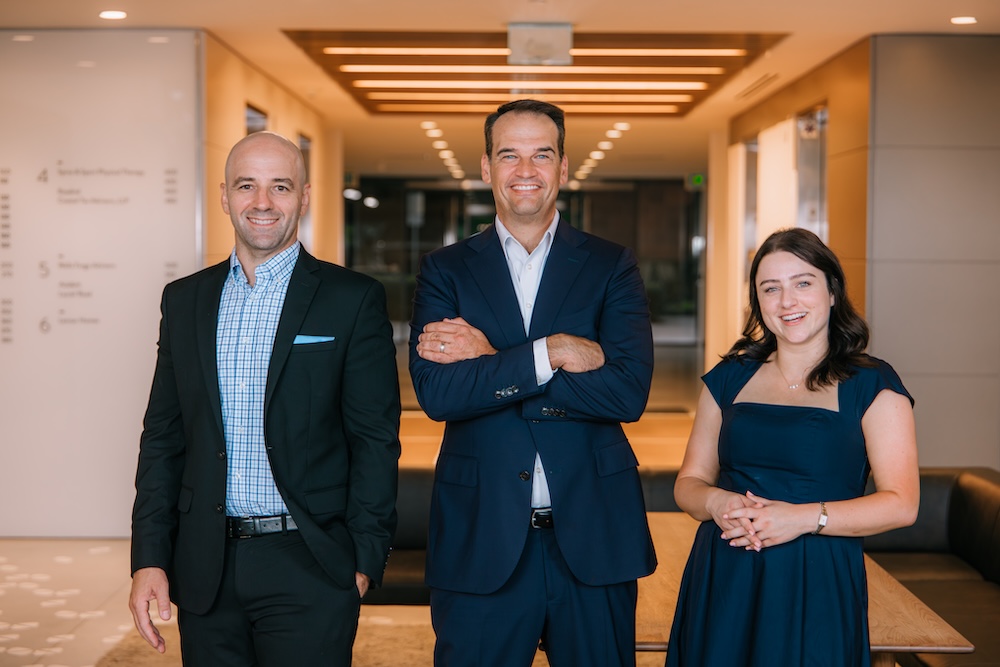
“I have five other partners,” he explains. “We work together, we work very hard, we’re trying to support this business so we can take home some money to take care of our families but also make sure our clients, our friends over here, can make money.”
It’s the closest approximation of private lending and law firm management that makes sense to an eight-year-old, but the emphasis is telling. Even explaining his job, Kim talks about people before titles.
His daughter is beginning to see what Kim sees: relationships are their own kind of currency. Always more excited talking about his kids than the intricacies of legal work, Kim says his daughter is starting to understand that people matter more than transactions. She’s developing a sense of what it means to look out for people, and that the effort invested in relationships tends to come back around. The lesson, Kim says, feels more concrete echoed back.
A protective instinct is only half the lesson; the other half is the relentless effort required to back it up. He and Sieum Lim tell both their daughters the same thing after trips like the recent one to Hawaii: “We’re able to do these things because of hard work. Not because Daddy’s on YouTube. Because of hard work for the past 15 years, and the past 30 years.” Then, characteristically, he adds: “And luck. And God’s grace.”
But if luck and grace are abstract concepts, his wife, a CPA who works in transfer pricing, is the tangible foundation. For Kim that foundation comes through loud and clear: Sieum Lim is where it starts and ends. “I wouldn’t have achieved half of what I’ve done without her support.”
Most of the work that built Kim’s reputation happened may have happened in public, but the bedrock is somewhere else.
Still Unapologetically Loud
At some point in this industry, if you do the work long enough, people start making introductions you didn’t ask for. Kim mentions an incident almost in passing to drive that home: Someone writing a report on rental transition loans for the Urban Institute needed to interview relevant people, and Linda Hyde, AAPL’s president, pointed them to Fortra. Prospective clients arrive the same way, hearing about Fortra from someone else.
He says these moments are evidence, not objectives. “That’s really rewarding,” Kim says. “I guess that comes with influence, but I think it’s just rewarding that we know that our hard work has really paid off. What the firm has put together as a whole … the message we’re trying to put out there … the resources we’re putting out there … is more where the influence lies.”
Spend enough time around Fortra and the family resemblance becomes obvious. The firm sounds the way it does—direct, willing to deliver the uncomfortable messages, pricing fairly when it could probably charge more—because of who built it and how. There’s no version of Kim that’s different off the stage than on it. The industry gets the same Kevin Kim his daughters do.
“I don’t know how to change that perception,” he says about being the loud Korean guy in the room.
He’s been saying that for 43 years. If he’s trying to change, he’s keeping the project remarkably quiet.





Leave A Comment