

You price risk, allocate capital, and build a return model around a specific timeline. When a borrower repays early, however, while you may recover the principal, you won’t recover the full return you and the borrower agreed was a fair exchange.
Especially on shorter-term loans, properly structured prepayment terms are part of the commercial bargain. They help you preserve yield and protect against costs that are easy to overlook but nonetheless real.
Unrecovered origination expenses are one example. Broker compensation, legal fees, underwriting, appraisal, and technology costs are all priced to amortize over the expected life of the loan. Early payoff leaves these costs partially unrecovered.
Capital drag is another. The 30 to 90 days (sometimes longer) between payoff and redeployment is dead time during which returned principal earns money market rates instead of loan-coupon rates.
Early payoffs also create warehouse and leverage friction. Paydowns to warehouse counterparties trigger borrowing-base recalculations and, in some cases, breakage costs on matched funding.
Secondary-market recapture is also a real exposure for lenders operating under forward-flow agreements, which often claw back premium or impose early-payoff penalties on the originator when a loan pays within the first three to six months.
Enforceability of prepayment penalties can vary dramatically depending on borrower purpose, collateral type, state law, and how a court characterizes the transaction. If you lend nationwide, especially on one-to-four-unit residential collateral, you cannot assume that a business-purpose label alone will always carry the day.
Your job is to protect the bargain before the loan closes.
The Economics
When you make a private loan, you commit capital for a defined term. You underwrite the borrower, evaluate the asset, negotiate the rate, and forecast your return. If the borrower pays off in two months instead of 12, your expected yield is materially reduced.
Consider the following scenarios for a $50 million portfolio, with 100 loans at $500,000, a 12-month term, a 10% interest rate, and a 60-day capital drag between payoff and redeployment. All estimates in the scenarios are approximate.
Scenario 1 (control, all loans run full term). The gross interest income is $5 million.
Scenario 2 (10% prepay at month 4, no penalty). The lender collects about four months of interest on those 10 loans ($167,000) instead of 12 months ($500,000), loses $333,000, plus $83,000 in drag on redeployed capital. The net hit is $416,000, about 8% of expected revenue.
Scenario 3 (10% prepay, 6-month minimum interest penalty). The penalty recovers the missing two months ($83,000) plus offsets drag. The hit shrinks to roughly $0–$50,000.
Scenario 4 (5% prepay because penalty discourages refis-of-convenience). This scenario features fewer disruptions, and they are mitigated when they occur.
Compounded over two, five, and 10 years, Scenario 2 is the one that forces a lender to either raise rates, tighten leverage, or shrink the book to keep returns whole. That’s the policy point worth making: Penalty bans don’t just shift money from lender to borrower; they shrink the pool of capital available to the next borrower.
A borrower who pays off in two months instead of 12 likely creates several problems.
Lost interest income. The return you modeled assumed a certain loan life. An early exit compresses that timeline and may render the original deal mechanics unviable.
Capital drag. In private lending, capital drag is the rule, not the exception, for two reasons. First, business-purpose loans almost always pay off in a lump sum at exit—through sale or refinance—rather than amortizing, so every payoff is a redeployment event. Second, origination pipelines are lumpy: A lender rarely has a fully underwritten, ready-to-fund loan waiting on the shelf the day a payoff hits. The industry rule of thumb is 30 to 90 days of cash drag between payoff and redeployment—longer if the lender is fund-structured and has to call capital or wait on warehouse advance mechanics. Scheduled maturity payoffs have drag too, but at least they are forecastable—the lender can line up the next deal against a known maturity date. Early payoffs are unscheduled, which is what makes drag worse, not just present.
Unrecovered origination costs. Broker compensation, legal fees, underwriting, appraisal, and operational expenses are all priced to be recovered over the loan’s expected life, whether held on balance sheet or sold into the secondary market. Early payoff leaves those costs partially or fully unrecovered.
Lost rate advantage. If you priced the deal into a specific rate environment, an early payoff means you may reenter the market under whatever conditions exist at that moment, which may be less favorable.
A prepayment penalty helps mitigate the disruption. Courts have generally recognized these provisions as a reasonable pre-estimate of damages that compensates the lender for the prepayment option granted to the borrower and protects the matched economics of the underlying funding.
Different Airspace
Private lenders finance investors, developers, and entrepreneurs across a wide range of business-purpose transactions. The purpose and structure of these loans make them fundamentally distinct from conventional consumer mortgages with 30-year terms secured by owner-occupied homes.
Business-purpose borrowers are more sophisticated. They often borrow through entities, are represented by counsel, and are willing to pay for speed, flexibility, and access to capital.
When your loan documents clearly disclose the prepayment terms and the borrower knowingly agrees to them, the prepayment premium becomes part of the negotiated economics of the transaction, closer to a contract buyout than a penalty.
Private lenders should not be apologetic about reasonable prepayment premiums. These provisions help keep capital available. When you can rely on the economics you underwrite, you can price loans more efficiently, sell them with greater confidence, and recycle capital into more projects. When prepayment premiums are uncertain or easily avoided, that uncertainty gets priced somewhere else, often through higher rates, tighter leverage, or reduced credit availability.
Reasonable prepayment protection benefits the market because it supports predictability. Borrowers want speed and certainty. Investors want yield and enforceability. You sit between those interests. Prepayment terms, when properly structured and disclosed, help align them.
Structure The Runway
A strong prepayment strategy starts with clarity and is defensible against the economics of the loan. Documents should state exactly when the premium applies, how it is calculated, whether a minimum interest requirement exists, and whether exceptions exist. Ambiguity is your enemy.
Common structures include a minimum interest period of three, six, or 12 months; a fixed percentage of the principal balance if prepaid within a defined period; a step-down structure that reduces over time; and a yield-maintenance or make-whole formula for larger or more sophisticated transactions.
For many private lenders, minimum interest is the cleanest approach. Borrowers who repay early still owe a defined amount of interest—simple to explain and administer.
That being said, the best structure is fact-specific and based on loan type, borrower profile, and state risk:
Fix-and-flip loans. A shorter minimum interest period is commercially reasonable because the borrower’s business plan depends on a quick exit.
Bridge loans. A step-down structure balances lender protection with borrower flexibility.
Larger commercial transactions. A yield-maintenance formula is usually appropriate.
The key is to match the provision to the economics of the deal rather than copying language from the last loan.
Create The Record
Never hide the prepayment penalty.
A borrower who discovers the premium at payoff is more likely to dispute it. A borrower who understands the terms at the outset accepts it as part of the economics of the transaction. That is why disclosure is both a compliance issue and a relationship issue.
Put it in the term sheet. Repeat it in the loan agreement. Make sure the borrower acknowledges it, ideally by initialing it. Where state law requires conspicuous disclosure or affirmative consent, build that into your closing process. Consider including it as standard practice across all your loans regardless of specific regulatory requirements.
Clear communication reduces borrower friction and strengthens your enforcement position.
Turbulence Risk
The biggest enforcement risk is whether the courts could recharacterize the loan as a residential mortgage.
You may call the loan commercial. The borrower may sign a business-purpose affidavit. The loan agreement may state that proceeds are for investment or business use. But if the facts suggest otherwise, a court may treat the loan as residential or consumer.
Some states restrict or prohibit prepayment penalties on certain residential mortgage loans. Depending on the jurisdiction, the analysis may turn on consumer purpose, the number of residential units securing the loan, borrower type, or how proceeds are used.
Your factual record matters as much as your contract language.
Build a file that clearly supports the commercial nature of the transaction. That means collecting and retaining business-purpose certifications, entity formation documents, operating agreements or corporate authority documents, borrower experience summaries, use-of-proceeds statements, draw schedules for rehab or construction loans, leases, business plans or investment documentation, non-owner-occupancy certifications, and email correspondence confirming the borrower’s investment intent.
Ask yourself whether a future court reading the file would conclude without hesitation that this was a commercial transaction, that the borrower knew what they were signing, and that the prepayment premium was part of the agreed economics. If the answer is yes, you are better positioned going into state-specific variances.
Check The Control Tower
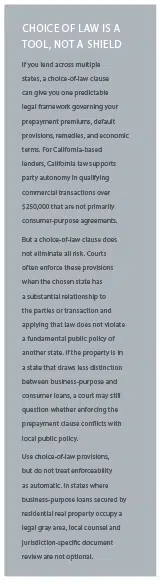
State-by-state variation affects pricing, documentation, secondary-market confidence, and enforcement strategy.
Some states present relatively low risk for clearly documented business-purpose loans. For example, states that limit prepayment restrictions to consumer-purpose credit generally leave more room to enforce commercial prepayment terms. In those jurisdictions, your main risk is usually whether the loan could be recharacterized as consumer rather than business-purpose.
Other states require more caution. While not exhaustive, Ohio, Pennsylvania, and Rhode Island are examples of various types of residential mortgage interpretations with potentially negative impacts on business-purpose loans. In Ohio, the law includes restrictions for certain residential mortgages, including limits on prepayment fees after specific time periods and prior caps. If a court treats the loan as a residential mortgage under the relevant statute, your prepayment premium may be capped or eliminated.
Pennsylvania’s residential mortgage framework focuses on loans secured by property containing two or fewer units, and some decisions have applied residential prepayment restrictions even in business-purpose contexts. That does not mean every business-purpose private loan is prohibited from carrying a prepayment premium, but factual records need to be especially strong and specific.
Rhode Island has limiting statutes that apply to loans secured by residential real estate with dwelling houses of not more than four units. Depending on whether the loan is purchase-money or nonpurchase-money, the law may impose specific limits, disclosure requirements, consent requirements, and timing restrictions. In states like Rhode Island, compliance with the local framework may be more important than relying solely on your governing-law clause.
What This Means for You
Prepayment premiums are a core portfolio-management tool, not boilerplate and not a borrower punishment.
They protect yield, support capital planning, and reinforce the commercial bargain. But they must be drafted, disclosed, and documented with care.
Four factors establish the strongest enforcement position: clear contract language, a valid governing-law clause, strong business-purpose documentation, and state-specific legal awareness.
Getting repaid early may look like a win, but unless you protected the economics of the deal, you have not received the full return the borrower promised to pay in exchange for your speed, flexibility, and higher risk tolerance. Prepayment clauses help ensure that when the borrower exits early, you still receive the benefit of the bargain you made.






Leave A Comment