

Three years into a slow-motion correction, local market experts see more softness ahead before conditions improve.
Spiking mortgage rates in the second half of 2022 shocked the housing market out of its pandemic-triggered sugar high and initiated a slow-motion correction characterized by sluggish sales and anemic price appreciation over the last three years. Local community developers buying distressed properties at auction expect that slow-motion correction to continue for at least another year, although they are seeing some signs of light at the end of the tunnel.
“(I am) expecting more inventory in the second quarter of 2026. This is impacting how I am currently investing as more inventory will most likely lower overall prices,” wrote Patrick, an Auction.com buyer from Ohio, responding to an annual buyer survey in February 2026.
Since January 2024, nationwide home sales have flatlined near a three-decade low of about four million on an annualized basis, according to data from the National Association of Realtors (NAR). U.S. home prices have averaged an uninspiring 2.4% in annual appreciation since then, with eight months where home prices decreased from a year ago. Three of those months have come in the last year, including a 2.2% drop in January 2026. Home prices were up just 0.9% in April 2026, the most recent data available from NAR.
About 30% of markets saw decreasing home price appreciation in April, according to data from Intercontinental Exchange (ICE). Those included Cape Coral, Florida (down 5%), Austin, Texas (down 4%), Seattle, Washington (down 2.4%) and Denver, Colorado (down 1.9%).
More Expect Home Price Declines
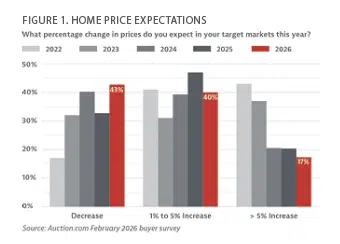
A growing share of local market experts expect home prices to continue to decline in their local markets in 2026, according to a February 2026 survey of more than 400 Auction.com buyers (see Fig. 1). Most of those buyers are local community developers who track their local market conditions carefully and whose success as real estate investors depends on accurately anticipating future trends in their market.
Forty-three percent of buyers surveyed said they expected home prices in their local market to decline in 2026, up from 33% in a 2025 survey to the highest share reported since 2022, when the survey began. Meanwhile, 40% expected home prices in their local market to increase between 1% and 5%, down from 47% in the 2025 survey to the lowest level since the 2023 survey. The remaining 17% of buyers surveyed said they expected home prices in their local market to increase more than 5% in 2026, but that was the lowest share expecting a 5-plus percent increase since the survey began in 2022.
Price Expectations by Region
By geography, the survey data largely tracks with trends in the sales data cited in Figure 1. Buyers in the Central region of the country, which includes Texas, Ohio, Michigan, and Illinois, among other states, were most likely to expect decreasing home prices in 2026 (50%) followed by the Southeast (49%) and the West (47%).
Only 37% of buyers in the Northeast, which includes New York, New Jersey, Virginia, and Pennsylvania, among other states, said they expected home prices to decrease in 2026, the lowest of any region.
“I’m waiting for the market to come back down a bit,” wrote survey respondent Jolene from Pennsylvania.
More Expect Retreating Rents
A record-high share of local housing market experts are also expecting rent rates to decline in 2026, according to the survey data. Nearly one-third of all buyers surveyed (31%) said they expect rent prices to decrease in their local markets in 2026, up from 26% in 2025 to a record high as far back as 2023, when this question was first asked in the survey (see Fig. 2).
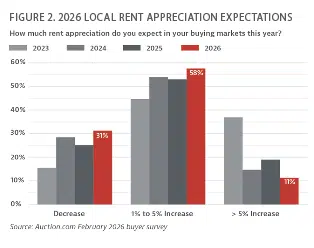
The survey results painted a bit better picture for rent expectations than it did for home price expectations, however. The majority of buyers surveyed (58%) expect a modest increase of 1-5% in rents in 2026. Still, only 11% expected rents to increase more than 5% for the year—a record low for the survey.
Buyers in the Southeast, which includes Georgia, Florida, Tennessee, and Alabama, among other states, were the most likely to expect decreasing rents in 2026 (42%), followed by buyers in the West (38%).
“Rental inventory and pricing determine our investments,” wrote survey respondent Robert from South Carolina.
Buyers in the Central region (28%) and Northeast (27%) were closely aligned in terms of the share expecting decreasing rents in 2026.
According to a Realtor.com report, the survey results aligned closely with trends in asking rents, which declined nationwide on an annual basis for the 32nd consecutive month in March 2026 for 0- to 2-bedroom properties.
The report shows median asking rents declined on an annual basis in 34 of the 50 largest U.S. metropolitan areas in March 2026 (68%), including Austin, Texas (down 6%), Oklahoma City (down 5.3%), Memphis, Tennessee (down 4.9%), Phoenix, Arizona (down 4.5%), and San Antonio, Texas (down 4.5%).
Fewer Overvalued Markets
Although a rising share of local housing market experts are expecting declining home prices and rents in their local markets in 2026, a record-low share sees their market as overvalued—evidence that the slow-motion housing correction over the last three years has helped to improve affordability, albeit gradually (see Fig. 3).
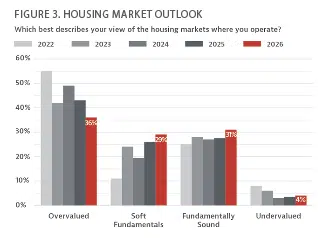
More than one-third of buyers surveyed (36%) described their local housing market as “overvalued with a correction possible.” That was down from 43% in 2025 to the lowest level since Auction.com began conducting this survey in 2022.
Survey respondents in the West, which includes Arizona, California, Colorado, and Washington, among other states, were most likely to describe their local market as overvalued (43%) followed closely by survey respondents in the Southeast (42%).
Conversely, 31% of buyers surveyed described their local market as “fundamentally sound with solid growth,” up from 28% in last year’s survey to the highest level since the survey began in 2022.
Survey respondents in the Northeast were most likely to describe their market as fundamentally sound (39%) followed by survey respondents in the Central region (32%).
Twenty-nine percent of buyers surveyed described their market as having “soft fundamentals with select opportunities,” up from 26% a year ago to a record high for the survey.
Only 4% of buyers surveyed described their market as “undervalued with strong upside,” unchanged from a year ago.
More Bullish on Property Purchases
The gradually improving home affordability landscape resulting from the slow-motion housing correction over the last three years, particularly in the Southeast and West, is helping local market experts in some areas of the country to become more bullish about purchase expectations in 2026 (see Fig. 4).
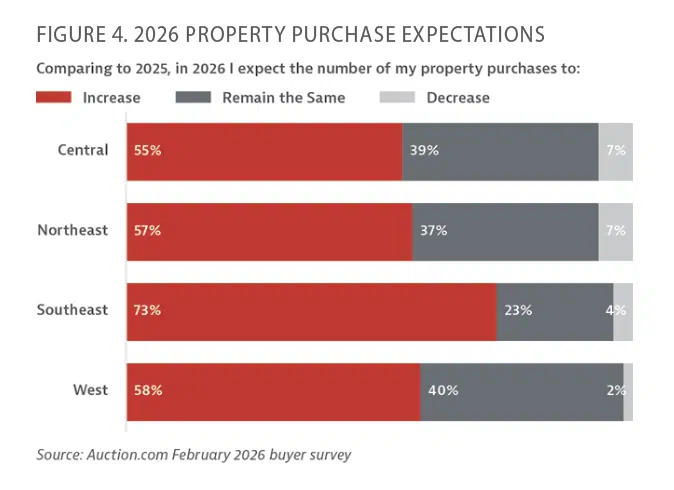
Nationwide, 92% of all buyers surveyed said they expect their property acquisitions to increase or remain the same in 2026 compared to 2025, down from 94% in the 2025 survey to the lowest level since 2023.
But buyers in the West and Southeast were more likely to have bullish property purchase expectations for the year. Ninety-eight percent of buyers in the West and 96% of buyers in the Southeast said they expect purchases to increase or remain the same in 2026.
“I have bought four properties on Auction.com. Looking to buy more,” wrote survey respondent William from Tennessee.
Taken together, the survey data paints a picture of a housing market that remains under pressure but is gradually working through its excesses. Affordability has improved, overvaluation concerns have eased, and buyers in some regions are growing more confident about acquisitions. The correction is not over, but for patient local market operators, the light at the end of the tunnel may be getting a little brighter.






Leave A Comment