

Anyone active in the Residential Transitional Loan (RTL) securitization market is familiar with the question that comes up when a portfolio is being assembled for a deal: “What do we do with the loans backed by 5+ unit multifamily properties?” The answer is usually some version of “Keep the concentration low, treat them conservatively, and move on.”
That approach made sense when multifamily loans were a small part of the market. It will make far less sense going forward.
As the RTL industry matures, more borrowers are gaining experience and renovating larger, higher-density properties. The collateral is evolving and the framework must evolve with it.
The multifamily RTL (MF RTL) market has grown meaningfully in scale and sophistication. Borrowers are more institutional, business plans are more detailed, and the properties themselves, including urban single-family density conversions to 5-story walk-ups and suburban value-add repositionings, represent a distinct credit profile deserving a distinct capital markets treatment.
MF RTL market growth presents an opportunity to introduce an entirely new investor base to RTL securitizations: commercial real estate (CRE) investors already active in bridge lending but largely absent from today’s RTL securitizations. The question is whether the market is ready to structure and distribute the product appropriately.
Major structured finance asset classes started as something that did not fit the existing boxes. Non-qualified mortgage-backed (non-QM) securities, for example, began as outliers and grew to nearly 15% of the mortgage market, with $76.5 billion issuance in 2025, with its own framework, investor base, and performance history. Multifamily RTL sits at that same turning point.
Current State
Most RTL securitizations are built and evaluated on a residential model, reflecting the segment’s single-family transitional loan roots. Rating agencies operating within Residential Mortgage-Backed Securities (RMBS) frameworks often limit exposure because the approach for evaluating multifamily properties falls within commercial mortgage-backed securities (CMBS) methodologies, which is outside of their groups’ purview.
RMBS teams are unable to rate any pools with a material portion of multifamily loans, and the small number that do reach rated deals are subject to conservative assumptions—such as higher volatility scores—that ignore the assets’ location, value, income potential, and operational strength.
The result is a mismatch between the asset class and the framework used to evaluate it, not a reflection of any inherent weakness in the class itself.
Defining Multifamily RTL
A critical first step is clarity of definition. MF RTL generally consists of:
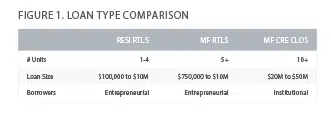
Loan Size. These are typically $750,000 to $10 million, near the lower bound of CRE securitization loan sizes.
Unit Count. In major urban markets, units range from five to 10, with valuations of approximately $500,000 per door. In suburban markets, this can extend to 20 or more, where values are closer to $100,000 per door.
Mixed-Use Properties. This is defined as properties where at least 50% square footage of the rent roll is residential and often includes ground-floor retail or neighborhood commercial use.
Business Plan. Transitional execution is rehabilitation, lease-up, or repositioning. Payoffs are expected to be via sale or refinance into stabilized loans (e.g., small-balance CRE programs like Freddie Mac Small Balance Loans and Fannie Mae Small Loans).
A Hybrid Asset
Multifamily RTL loans sit between residential and commercial real estate, as Figure 1 shows. On the one hand, they reflect residential characteristics such as entrepreneurial borrowers, short-term bridge financing, and local market dynamics. On the other, they behave like commercial assets, where outcomes depend on income generation, tenant stability, property condition, and sale or refinance upon stabilization completion.
Multifamily RTLs materially differ from Multifamily CRE Collateralized Loan Obligations (CLOs), which are generally backed by larger loans, institutional sponsorship, and fully developed commercial underwriting frameworks.
MF RTL requires rapid underwriting and flexible, asset-based evaluation—qualities that conflict with the slow, costly, and risk-averse processes traditional institutions apply to higher-balance CRE loans. Conversely, RTL lenders can originate MF RTLs but do not yet have a securitization framework that reflects the diligence package CRE investors are familiar with.
That disconnect leaves MF RTL in between markets: too operationally intensive for CRE platforms and too asset driven for traditional residential securitization frameworks.
That gap creates an opportunity to connect two investor bases that have historically remained separate.
Expanding the Investor Base
Capital is the key to unlocking stand-alone MF RTL issuance: A broader investor base has the will to improve pricing, increase competition, reduce reliance on a narrow buyer group, and deepen market liquidity.
A large group of CRE investors already understand the risks embedded in transitional multifamily lending through exposure to debt funds, balance sheet lending, and CMBS. However, they have limited appetite for RTL securitizations, largely because the product has not been presented in a format that aligns with one they can easily evaluate.
Here’s the framework to fix that:
The Pilot. Before bringing a stand-alone multifamily deal to the CRE investor market, issuers must demonstrate the ability to underwrite and present collateral to commercial real estate standards, as outlined in a standard CMBS multifamily due diligence package:
Asset Summary Reports (ASR) that tell the story of the business plan, market, and path to stabilization.
Rent roll analysis with market-level rent details.
Third-party reports including appraisals, property condition reports, environmental studies, and seismic reviews where warranted.
These elements are standard in CMBS but largely absent from current RTL securitizations. Closing this gap is essential, not because rating agencies demand it, but because new investors will.
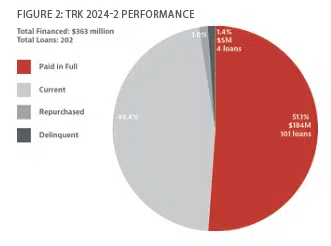
Preliminary proof-of-concept for the structure already exists in the form of unrated securitizations, the first of which was TRK 2024-2 as the first to be comprised entirely MF RTL transactions. The October 2024 issuance was initially backed by 98 loans totaling $166 million. As of the April 2026 remittance report, those figures have grown to 202 loans totaling $363 million during the revolving periord. See Figure 2 for performance details.
Although there has not yet been another stand-alone MF RTL issuance, the ICAP 2025-RTL1 issuance in July 2025 had an initial concentration of 82.6% MF RTL.
Investor Education. Even strong collateral and sound structures can fail without effective communication. Issuers must maintain their existing investor relationships while actively engaging CRE investors who are new to the RTL market.
This requires presenting deals in commercial real estate terms, with asset-level documentation (i.e., multifamily due diligence packages) and a clear explanation of how transitional multifamily risk differs from stabilized assets in traditional CMBS transactions. A well-executed marketing process can expand the buyer pool and improve execution.
For this, the advisory team matters more than the rating agency. A team focused solely on residential execution may struggle to reach CRE investors. Successful execution requires fluency in both markets and established investor relationships.
Rating methodology dialogue. This stage is key to engaging CRE investors who require institutional-grade diligence. With data and infrastructure in place, issuers can engage rating agencies in refining how multifamily collateral is evaluated. Greater emphasis should be placed on stabilized value, testing renovation assumptions, and analyzing income-based metrics such as debt yield and debt service coverage ratios upon renovation completion and stabilization.
The goal is to extend the existing residential framework. A hybrid approach preserves borrower-level insights while incorporating the asset-level analysis CRE investors require. This also makes the product more understandable to both existing and new buyers.
Repeat Issuance. Markets are built through consistency. Over time, repeat transactions allow investors to build familiarity, confidence, and pricing. TRK 2024-2 priced with a discovery premium because investors wanted to be compensated for the novelty. As performance data grows and investor understanding improves, execution becomes more efficient. Repeat issuance also builds the track record required for institutional capital to participate at scale.
A critical and often underemphasized component of repeat issuance is asset management and servicing capability. MF RTL requires hands-on asset management, particularly during the construction inspection phases and in downside scenarios. Operational expertise and the ability to manage transitional business plans at the asset level, lease-up execution, and recoveries can materially increase investor confidence and broaden participation.
What Success Depends On
Multifamily MF loans already exist and are already securitized within unrated RTL deals. Additionally, larger-balance MF RTL loans are already rated within the CRE CLO framework, so regulatory change is unnecessary.
Although competition among ratings agencies may improve outcomes at the margin, having just one agency willing to enter the dialogue is enough to start the shift for smaller-balance MF RTLs. The true test is the industry’s ability to change the approach by engaging teams that can operate across both residential and commercial frameworks, adopting ResiMercial due diligence and treating MF RTL as commercial from the outset, and expanding distribution beyond traditional residential buyers.
Every asset class begins as an exception. MF RTL is no different. The firms that move early will both improve execution and help define the market itself, an advantage that compounds over time.



Leave A Comment