
As AI-driven image manipulation accelerates, private lenders must rethink how they authenticate visual proof of progress.
The private lending industry has a long history of balancing opportunity with operational risk. During the past decade, underwriting and compliance have grown more sophisticated, targeting credit quality, valuation variances, and lien position integrity. Yet much of the industry still relies on borrower-submitted photos and videos to support property valuations, collateral condition, and construction progress.
Those visual workflows drive funding decisions, geographic expansion, and portfolio flexibility. But as lending’s digital infrastructure has matured, a new and formidable threat has emerged: fake and manipulated media.
Generative AI and advanced image editing software have turned images and videos into a new high-risk category: visual risk. Fraudsters can now fabricate or alter convincing media in minutes, at virtually no cost.
In financial services, AI-driven fraud is increasing in both frequency and sophistication. Deloitte projects that fraud losses tied to generative AI could reach $40 billion in the U.S. by 2027, up from $12.3 billion in 2023. That’s an annual growth rate of roughly 32%. Industry researchers underscore the scale of the problem: Deepfake and synthetic media files skyrocketed past 8 million globally in 2025, up from half a million just two years earlier.
The traditional assumption that ”seeing is believing” no longer holds up when AI-generated content enters the loan workflow.
Why Visual Fraud Thrives in Private Lending
Multiple factors are driving the rise of visual fraud. Generative AI tools are easy to access, inexpensive, and require little technical skill. Nearly anyone can generate new images as “proof,” enhance old photos to appear current, or remove critical defects. At the same time, lenders face mounting pressure for speed and efficiency, which is a dangerous combination. Unchecked visual fraud can trigger a cascade of negative outcomes, including:
Direct financial loss. Over-advanced loans can leave lenders short on recovery when defaults occur.
Operational headaches. Disputes, reinspections, and staff time spent investigating issues erode efficiency.
Data integrity issues. Portfolio analytics, forecasting, and capital allocation all suffer when visual documentation is unreliable.
Loss of investor confidence. Secondary market partners and institutional investors increasingly scrutinize draw verification and fraud mitigation protocols.
AAPL’s fraud guidance notes that investment real estate transactions are susceptible to various types of fraud, including entity and title fraud, appraisal and valuation manipulation, and cybercrime. In construction lending, staged photos and creative cropping have been used to falsely represent project progress. Fraudsters have photographed one finished section of drywall and submitted the same angle repeatedly as evidence of progress across multiple stages or properties. More sophisticated tactics include photographing retail locations and passing off inventory as on-site improvements.
Visual fraud compounds the structural characteristics of private lending that already heighten exposure. Competitive market dynamics reward rapid funding. On-site physical inspections are often replaced by remote verification, especially for projects located out of state. Borrowers and contractors now routinely submit photos and videos as evidence of progress. Industry reporting shows that 70% of contractors regularly experience payment delays, with most eager for faster, near-instant funding once milestones are met. As verification processes shift online, they become more vulnerable to manipulation. The result is that a single deceptive image or video can trigger a substantial draw, leaving lenders exposed if the collateral does not match what is depicted.
Traditional Fraud Checks Can Fall Short
Manual photo examination, metadata checks, periodic site visits, and other conventional controls for fraud detection have not kept pace with modern risks. Human review is unreliable when AI can seamlessly alter images, digitally remove unwanted flaws, or manufacture new content without obvious indicators. Metadata, such as timestamps and GPS coordinates, can be stripped or forged with basic editing tools. Even live video calls are not immune because selective camera angles or AI-powered filters can mislead reviewers. Remember, “live” does not always mean authentic.
Compounding these risks, the cost and logistics of in-person verification add significant pressure. A traditional site visit for draw or inspection often exceeds $100 per property, especially in suburban or rural locations. Multiply that by multiple draws and a growing portfolio, and lenders face substantial recurring expenses, which is why lenders turn to virtual verification and manual photo review in the first place. Yet not all virtual approaches are equally secure. Quickly reviewing borrower-submitted images may save time, but it introduces risk if you can’t independently verify their authenticity. The challenge is maintaining confidence in verification without slowing down workflows or raising operational costs.
Building Resilience
As generative AI and media manipulation accelerate, the industry must evolve to keep pace. Lenders who combine rapid funding with strong authentication and verification practices will be better positioned to compete and protect their portfolios.
For example, Boomerang Capital Partners initially had issues verifying whether borrower-submitted photos accurately reflected completed work tied to draw requests. Some pictures were found to be sourced from unrelated job sites. Uncovering this fraud prompted operational changes. After adopting robust photo verification and inspection processes, the lender was able to fund draw requests in less than 30 minutes because inspection details and borrower-submitted visuals were authenticated.
After implementing verified inspections and a standardized process, Boomerang Capital significantly reduced its exposure to fraudulent or misleading images and caught inconsistencies before funding decisions were made. The shift also streamlined internal reviews, replacing manual photo checks with authenticated property details, and strengthened confidence across the portfolio.
Boomerang Capital Partners also observed that investors showed greater trust and more willingness to participate in funding: “Our partner organizations—whether it’s the institutions that provide our credit facilities or the buyers of our loans—they appreciate seeing that we take this process extremely seriously,” said Christopher Marohn, senior vice president of operations at Boomerang Capital Partners.
AAPL Member Training Course
Private lenders face a rapidly evolving landscape of digital deception. As image manipulation and AI-generated content become more sophisticated, keeping up with the threat requires more than general awareness. Ongoing education and practical skill-building are essential for staying ahead of fraud schemes and protecting your portfolio.
AAPL, in collaboration with Truepic Vision, is offering a dedicated Media Fakes & Misrepresentation course free for AAPL members.
This program addresses the latest tactics in photo and video fraud, highlights the financial impact of these threats, and breaks down real-world risk mitigation strategies relevant to private lending operations. Here’s an overview of what attendees will learn:
Types of visual fraud. Learn to identify staged photos, AI-edited images, time/place misrepresentation, and collusion, using examples drawn from active lending environments.
Case studies and practical examples. Explore recent cases where fake or misleading media triggered significant losses or operational issues for lenders.
Fraud detection and response. Understand the limits of manual review, where fraud technology fits in, and what trusted image and data authentication really means.
Knowledge checks and tools. Apply learning through real/fake challenges, practical checklists, and step-by-step guides for internal review and response.
Strategic risk mitigation. Discover how lenders across the country are updating their processes to reduce exposure while maintaining efficiency and service standards.
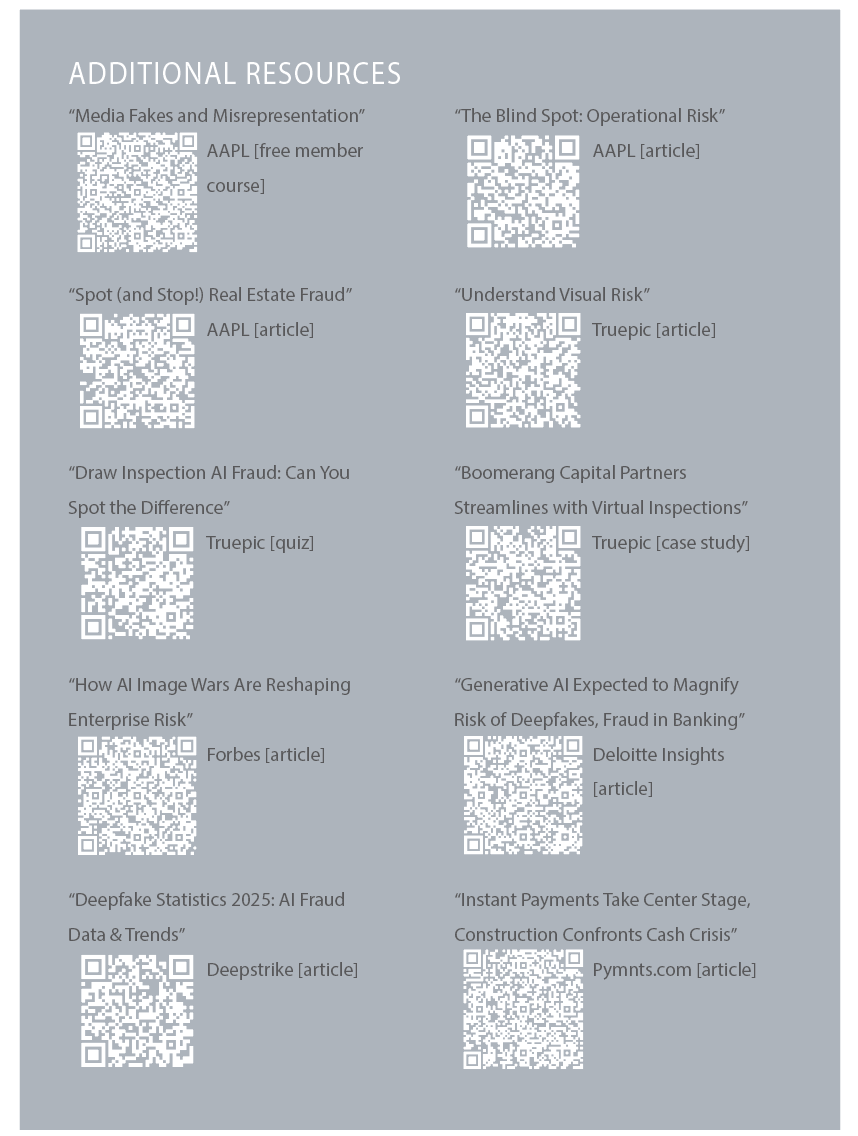
The course is designed for lending professionals, fund managers, compliance leaders, and anyone responsible for operational risk or loan review in private lending. Whether you oversee a team or review funding yourself, the material equips you with actionable tools for today’s digital-first lending landscape. AAPL members can access the Media Fakes & Misrepresentation course at no cost (see the Additional Resources sidebar).






Leave A Comment