

In a high-rate, high-payment environment, the projects and lenders who succeed are precisely aligned with local buyer demand.
The housing market during the past two years has been reshaped less by dramatic price swings than by subtle shifts in buyer behavior, local supply constraints, and the psychology of affordability. Although consumer mortgage rates have hovered near 6-7%, private-money rates for real estate investors have also stabilized at elevated levels, creating a financing environment where both retail and investor borrowers are making more deliberate decisions.
These higher carrying costs haven’t reduced demand so much as redirected it—toward projects that demonstrate clear value and strong alignment with local buyer expectations. In conversations with builders, brokers, and investors across the country, there is a clear pattern: The projects succeeding today fit their local market with precision.
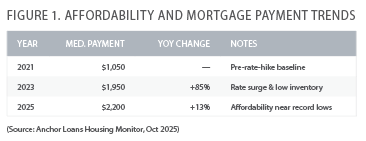
What’s changed most is not demand itself, but the way buyers evaluate value. With monthly payments substantially higher than in 2021, buyers are more thoughtful, more discerning, and more focused on how a home aligns with their daily life. This is reaffirmed in Anchor Loans’ U.S. Housing Monitor data, which shows stabilization rather than appreciation in many metros—yet a striking disconnect between properties that “fit” their neighborhood and those that don’t. The spread in absorption times has widened. Homes aligned with local expectations are moving quickly; others are sitting noticeably longer. Instead of stretching for square footage, prospective homebuyers are prioritizing homes that function well for the way they actually live. The affordability pressure shown in Figure 1 is the clearest driver of that shift.
This bifurcation is something our originators feel every day. Kristin Young, vice president of originations who covers D.C. and Maryland, recently told me: “Condos and entry-level units are sitting, but well-located single-family homes are moving in days—often all-cash and full price. We’re back to a market where location matters again.”
She’s right. But what she’s describing is more than geography. It’s the return of livability as the core driver of value. Buyers aren’t compensating for a lack of function with low rates anymore. They expect homes that make daily life easier. When that expectation is met, even in higher-rate environments, demand is resilient.
This is where lending intersects directly with product-market fit. For lenders, these nuances aren’t just interesting. They influence loan performance, construction timelines, and investor outcomes. Understanding how a product will resonate with the neighborhood is now a fundamental part of evaluating risk. The conversations we’re having earlier in the lifecycle—before a term sheet is issued—often make the difference between a smooth project and one that struggles.
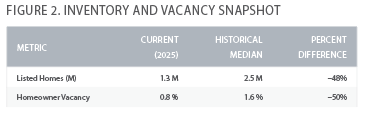
The data underscore what our teams are seeing in the field: Supply constraints are still defining the market. With active listings and vacancies at nearly half of historical norms, even small submarket differences can create outsized swings in demand (see Fig. 2).
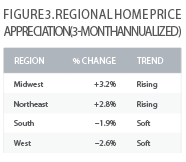
Across many regions, particularly the Midwest and Northeast, inventory remains tight enough to support steady price performance. Yet broad regional data often masks major differences at the neighborhood level. In one ZIP code, demand can surge; one mile away it can soften. What consistently separates faster-moving projects from slower ones is how well the investor reads the micro market and matches their scope and design decisions to the buyers who are active in that specific area (see Fig. 3).
Blake Rivers, Anchor Loans’ vice president of originations handling South Florida, put it plainly: “There are great deals in every region, but the investors who consistently succeed are the ones who really understand their local market. A design that works in Phoenix won’t automatically sell in Seattle. When builders match product to buyer expectations in their local market, that’s when projects fly.”
Rivers’ insight matters because it applies equally to lenders. A lender who treats two projects as equal because they share an ARV or LTV target is missing the deeper evaluation. Product-market fit is not a luxury consideration. It’s a risk indicator.
Through conversations with our sales team, a theme continues to emerge: Livability has become a form of insulation in a high-payment environment. Buyers reward homes that reduce friction in daily routines: functional storage, thoughtful floor plans, spaces that accommodate hybrid work, and layouts aligned to how families actually live. These aren’t cosmetic distinctions. They materially shape both time-to-sell and pricing power.
As Rivers noted: “Every feature that makes someone’s life easier shows up in resale velocity. That’s not cosmetic. It’s profitability.” For lenders, this is a critical insight. When a home is designed around practical utility, the investor’s margin becomes more durable, and the lender’s exposure becomes clearer. When a home is misaligned with its buyer pool, small cost overruns or slight pricing adjustments can erode the entire project. In today’s environment, understanding this distinction is essential.
If there’s a unifying takeaway from our teams on the ground, it’s that consultative lending is no longer optional. Investors are not just looking for capital; they’re looking for clarity. They want lenders who can read a market, spot execution risk early, and help validate whether a project is aligned with the right buyer.
This doesn’t mean telling developers how to build; it means helping them see the market with sharper resolution. The most effective originators now ground their conversations in real, local data: cost-per-square-foot trends, days on market by product type, absorption shifts within neighboring ZIP codes, and how similar renovation scopes have actually performed. In practice, this turns market intelligence into execution insight, giving investors a meaningful edge before the first dollar is deployed.
The strongest originators have evolved from being facilitators of capital to being interpreters of the market. They ask different questions now: Who is the buyer? What are they responding to in this neighborhood? Does the scope align with what moves here? How confident are we in the investor’s execution in this specific submarket? These discussions don’t slow deals down; they de-risk them.
For lenders, the question is no longer just “How do we price this loan?” It’s “How do we deepen our confidence in this borrower, in this product, in this micro-market?” And that requires a more layered understanding of demand patterns, investor expertise, and execution risk.
Lenders who succeed in 2026 will evaluate projects through both a financial and functional lens, supporting borrowers not just with capital but with perspective. Investors who value this naturally seek out lenders who can anticipate risks early and help them navigate what the market is signaling next. In a market where outcomes are won or lost on details, that partnership becomes a true competitive advantage.
In a year defined less by volatility and more by discernment, the ability to read the nuances of local demand and help borrowers turn those nuances into strategy is what will set the best lenders apart.







Leave A Comment