

Did you sell the loan, or finance it? Every private lender entering a loan participation should answer that question upfront, but it often surfaces later in an audit meeting, when the accounting treatment does not align with the financial statements. At that point, the focus shifts from deal structure to damage control.
Loan participations are flexible, valuable private lending tools. They are also one of the arrangements lenders most frequently get wrong on the books. The reason is almost always the same: The legal structure and the accounting framework are answering two different questions, and most lenders only realize the difference when something forces the issue.
The core of the issue is more simple than it sounds. ASC 860, the rule that governs transfers of financial assets, draws a hard line between a transfer that qualifies as a sale and one that doesn’t. A participation can fall on either side. Many private lending participations end up on the wrong side, as secured borrowings rather than sales.
Current Market
Participations are appearing more frequently, not just at large platforms. Mid-sized and growing originators are using them as a regular capital strategy, often with multiple participants on the same loan. What was once relationship-driven has become a repeatable part of the funding model.
Several factors are driving that change: capital efficiency matters more, higher rates and tighter liquidity are pushing lenders to keep originating without fully deploying their own balance sheet, and participations make that possible without losing the borrower relationship. Growth in DSCR and rental lending has also extended holding periods, making capital recycling more important.
Institutional pressure is another driver. Even lenders not using institutional capital today are feeling its influence on how deals are structured. Investors want exposure to these loans, and participations offer an accessible entry point that raises the bar on documentation.
Participations are growing fastest among mid-sized lenders with established origination pipelines and active investor relationships but still actively managing capital deployment. For those lenders, participations have stopped being a one-off tool and started becoming a routine part of the model. That’s also the point at which the accounting catches up with you.
What Is A Participation?
A participation lets a lender share the economics of a loan while continuing to manage the borrower relationship. The lender originates and typically services the loan, and the participant contributes capital and receives a share of cash flows.
Nothing changes for the borrower. For the lender, the structure introduces a second layer of complexity, because two questions now need answers: Who owns the loan, and who controls the loan? Those answers determine everything about how the transaction is accounted for.
Beneath the Surface
Under U.S. GAAP, ASC 860, the accounting analysis for a participation runs in two steps. Most private lending participations don’t make it past the first.
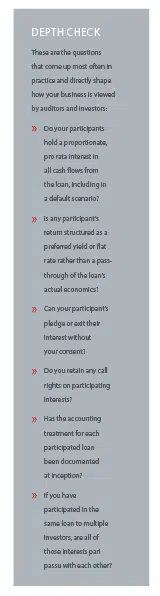
Step One: Does the Interest Qualify as a Participating Interest? Before any transfer can be considered a sale, ASC 860 requires the transferred portion to meet the definition of a participating interest. This is a threshold test, and it is more demanding than most lenders expect. The transferred interest must represent a proportionate, pro rata ownership interest in the entire financial asset from the date of transfer. Cash flows from the loan must be divided proportionately among all interest holders, with no holder receiving a disproportionate share of principal versus interest. No interest holder’s interest can be subordinated to another—all holders must share on a pari passu basis, including in default scenarios—and no holder can have recourse to the transferor beyond standard representations and warranties.
This is where many private lending participations fail. If your participant receives a preferred return, has priority in a default waterfall, or if any interest in the loan is subordinated to another, the transferred interest does not qualify. Sale accounting is off the table and the analysis is over.
To illustrate: You originate a $2 million bridge loan at 11% and then sell a 50% participation on the principal with a flat preferred return interest rate of 9%. For this to meet the proportionality test, your participant would need a pass-through of 50% of the actual loan interest. It does not matter how the agreement is labeled. The accounting result is a secured borrowing.
Step Two: The Three Conditions for Sale Accounting. If the transferred interest qualifies as a participating interest, lenders then evaluate three conditions under ASC 860.
The first is legal isolation. The transferred interest must be legally isolated from you and your creditors, even in bankruptcy. In practice, this typically requires a bankruptcy-remote special-purpose entity holding the loan, supported by a true-sale legal opinion. In most private lending participations, no such structure exists. The loan remains in your name, the participant’s interest is contractual rather than ownership-based, and there is no legal separation between the asset and your company. That means the isolation condition is not met, and sale accounting is not available, making it the most common reason participations end up as secured borrowings.
A note on special purpose entities (SPE): Setting up a bankruptcy-remote SPE may address legal isolation under ASC 860, but it does not end the analysis. Under ASC 810, if the lender is the primary beneficiary, the SPE must be consolidated back onto the balance sheet, and the asset returns through consolidation. Clearing ASC 860 without also clearing ASC 810 increases legal cost without changing the accounting result, which is why the ASC 810 analysis is sometimes worth doing first. If consolidation is unavoidable, you save the time and expense of structuring around ASC 860 for a result that was never going to change.
The second is the right to pledge or exchange. The participant must have the right to pledge or exchange their interest without restriction. If the participation agreement requires your consent for the participant to exit, or if you retain a call option, you have not relinquished control and sale accounting is precluded.
The third is no effective control. You can’t retain effective control through a right or obligation to repurchase before maturity, or any ability to unilaterally pull the asset back.
If all three conditions are met, you recognize a sale and remove the participated portion from your balance sheet. If any condition fails, the entire transfer is treated as a secured borrowing.
It’s Probably Secured Borrowing
Secured borrowing accounting is the outcome for nearly all private lending participations. Under this treatment, the full loan remains on your balance sheet as an asset, and the participant’s contribution is recorded as a liability, effectively a borrowing secured by the loan. You continue recognizing interest income on the entire loan while also recognizing interest expense on the participation liability. The result is a balance sheet larger than you might have planned, with leverage ratios that reflect it.
This catches many lenders off guard; knowing the correct treatment from the start changes how you structure, document, and report participations.
So why does this matter beyond the mechanics? Secured borrowing treatment is not necessarily a problem, but a grossed-up balance sheet may have real downstream effects.
Start with leverage. Because the full loan stays on as an asset and the participant’s funding sits next to it as a liability, both sides of your balance sheet are larger than they would be under sale treatment, but your equity is unchanged. Your leverage ratios go up and your return on assets goes down, even though the underlying economics have not moved. On paper, you look more leveraged than you actually are.
That balance sheet leverage can quickly flow through to your other capital sources. Warehouse lines and bank facilities almost always carry financial covenants tied to leverage, liquidity, tangible net worth, or borrowing base calculations. Secured borrowing treatment consumes headroom you may have been counting on—in a tight quarter that can be the difference between compliance and a technical default. It can also shape how investors value the business and how counterparties price your credit.
The income statement, by contrast, is mostly a wash. The bigger catch is gain on sale. Sale treatment can let you recognize a gain at closing. Secured borrowing spreads the economics over the life of the loan. If you have been counting on day one gain on sale income, it is not there.
Rough Water
What works on five deals gets harder at 50. The pressure points are predictable. They show up as small inconsistencies that accumulate until something like an audit, capital raise, or covenant test force them into view.
Start with the mismatch between legal structure and accounting treatment. The participation agreement is often drafted as a sale, with assignment language and a “purchase and sale” framing, but it contains terms that destroy sale accounting (e.g., preferred returns, consent rights on transfer, indemnities that go beyond standard reps and warranties). The legal team produced a sale document. The accounting team is required to call it a financing. There is not one correct legal structure for either outcome, but the agreement should be drafted with the intended accounting treatment in mind, rather than as a stock sale form with custom economics layered on top.
Then there’s the reporting problem. Picture three 50% bridge participations on similar loans. The first is a clean pro-rata pass through. The second gives the originator a 25 basis point servicing skim. The third gives the participant a flat 10% return. To you they look like the same product. Under ASC 860, the first might be a sale, the second is a closer call, and the third is clearly a secured borrowing. Three economically similar deals can end up with three different accounting treatments.
The operational piece is where it actually gets fixed. Internal systems that were never built to track participation liabilities separately from other debt make financial reporting harder than it needs to be. If you have knowingly committed to secured borrowing treatment going forward—which is the cleaner path for most private lenders—the fix is modest. It requires a dedicated general ledger account for participation liabilities (kept separate from warehouse and other facilities), a subledger that ties each participation liability back to the loan and the participant it relates to, and a process that records the inception date accounting conclusions alongside the loan onboarding documents. Most accounting systems already support this. The bigger lift is treating it as part of the loan onboarding workflow rather than something the accounting team reconciles at quarter end.
Documentation is another common challenge. ASC 860 requires the accounting conclusions on a participation to be made at inception, based on the facts as they existed at the time of transfer. That conclusion can’t be revisited later, which means an auditor or investor reviewing the books is really asking two questions: What treatment did you reach, and what was the basis for it at the time?
Without the support of the agreement, the analysis and the documented rationale, there is no way to verify the treatment was correct. The pattern is usually the same. Someone made the call informally and that person is gone now, or the bookkeeping just followed whatever the agreement said without anyone doing a GAAP analysis. On the light end, you get expanded audit procedures and higher fees. On the heavier end, you’re looking at proposed adjustments, prior-period restatements, or delayed transactions.
It is also worth understanding the risk of structure creep. Consider this scenario: You originate a $3 million DSCR loan and sell a 40% participation to Investor A on clean, proportionate terms. That interest qualifies as a participating interest, and the transfer is properly documented as a sale. A year later, the loan is performing well, and you bring in Investor B for a 30% participation. But this time, Investor B negotiates a preferred return rather than a straight pass-through. That disproportionate cash flow allocation means Investor B’s interest does not qualify as a participating interest. Because all interests in the same loan must now be reevaluated under ASC 860, Investor A’s previously clean participation is also called into question. What started as a well-structured sale turns into a restatement.
This scenario is occurring with greater frequency as lenders scale and bring in new capital partners with different return expectations. Fixing it after the fact is harder than preventing it, and the path depends on when you catch it. If the second participation hasn’t closed yet, the cleanest fix is restructuring Investor B’s terms to be pari passu with Investor A, having the same proportional cash flows, and no preferred return in order for both participations to qualify.
Once the second deal has closed, options narrow. You can try to negotiate or buy out Investor B’s interest, but that requires their cooperation, which usually isn’t free. More often the fix is recharacterized with Investor A’s previously clean sale being reversed and the entire participation structure on that loan being brought back onto the balance sheet as a secured borrowing. The fix requires being intentional about keeping all participations in the same loan on equal economic footing.
Navigate With Visibility
Loan participations can be an effective way to grow a platform, manage concentration, and access additional capital. But they also introduce accounting complexity that is easy to underestimate. The difference between a strong participation structure and a problematic one usually comes down to clarity around economics, control, and documentation from Day One.
If your participation structures have not been reviewed from an accounting standpoint, now is the time. Details that seem manageable early tend to compound as platforms grow, and fixing them under pressure is far more costly than addressing them up front.
Disclaimer: “Richey May” is the brand name under which Richey, May & Co., LLP and RM Advisory LLC provide professional services. Richey, May & Co., LLP and RM Advisory LLC practice as an alternative practice structure in accordance with the AICPA Code of Professional Conduct and applicable law, regulations, and professional standards. Richey, May & Co., LLP is a licensed independent CPA firm that provides attest services to its clients, and RM Advisory LLC and its subsidiary entities provide tax and business consulting services to their clients. RM Advisory LLC is not a licensed CPA firm.





Leave A Comment