

Private lending has entered an era where information abundance creates both strategic advantage and ethical instability. Lenders today can access traditional public records, aggregated datasets, scraped online content, behavioral indicators, predictive risk models, and vendor-generated borrower profiles whose sourcing and methodologies are rarely disclosed. The distinction between verified fact, probabilistic inference, and speculative noise has become increasingly difficult to identify.
This evolution presents a fundamental problem: the legality of accessing data is often mistaken for the legitimacy of using it. Many lenders possess enormous quantities of borrower information but without a coherent framework governing how to interpret, validate, document, or operationalize that information.
The resulting exposure is regulatory, reputational, operational, and structural. Poorly governed data practices can produce inconsistent underwriting outcomes, hidden bias, unreliable risk assessments, borrower distrust, and future scrutiny from regulators or litigants examining whether firms exercised reasonable judgment in their decision-making processes.
A defensible ethics model, therefore, becomes an institutional safeguard that helps lenders distinguish responsible intelligence gathering from reckless data opportunism.
Track Data Provenance
Modern borrower intelligence typically falls into the following four broad categories. For each one, lenders should still perform due diligence to understand source origin, verification status, update frequency, traceability, and confidence level. See Figure 1 for tier summary.
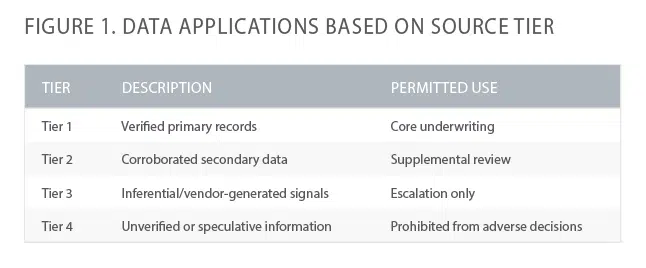
Tier 1: Primary Source Public Records. These records are generated directly by governmental or judicial authorities and are generally considered the most reliable category of externally sourced borrower information.
Primary records are not inherently error-free, but they do possess identifiable provenance and traceability. Rather than downstream interpretation, they are originated by institutions with governing agency. Examples include property ownership records, tax liens, UCC filings, court judgments, bankruptcy filings, business registrations, recorded deeds and mortgages, and licensing records.
Even for primary sources, contextualization is important. A decades-old lawsuit, dismissed lien, or resolved bankruptcy may have limited relevance to present-day borrower risk. Other data, while “potentially useful” information, are not defensibly useful to business-purpose credit decisioning and should not be collected.
Tier 2: Derivative or Aggregated Datasets. These datasets compile information from multiple public and commercial sources into searchable platforms. Derivative datasets increase efficiency but often degrade transparency.
Aggregation creates an illusion of authority. The same erroneous record replicated across multiple databases can appear independently verified when it is a single-source contamination event. Errors become both difficult to uncover and trace, so lenders should confirm with vendors where and how the information is sourced, and what confidence is placed on its accuracy. Examples include skip-tracing databases, credit header compilations, address histories, litigation aggregation tools, commercial borrower intelligence platforms, and data broker profiles.
Tier 3: Enriched or Inferential Profiles. The most ethically sensitive category involves vendor-generated intelligence products that infer characteristics, behaviors, or risk signals from fragmented data. These systems often combine verified and speculative information into a single output presented with unwarranted confidence. Examples include behavioral scoring, predictive default indicators, social relationship mapping, online reputation analysis, web-scraped identity associations, AI-generated borrower summaries, and device and location pattern analysis.
Tier 4: Unverified or speculative information. This includes information derived from unverified sources, AI-generated inferences, social media content, web-scraped commentary, predictive profiling, or other data lacking reliable validation. While such information may warrant further investigation, it should not be used to support adverse credit decisions because its accuracy, relevance, and fairness cannot be established with sufficient confidence.
Before using any data from these sources, lenders must ensure conclusions are fully defensible and not based on weak correlations. Vendors are incentivized to prioritize scale over accuracy, and their terms of service may transfer liability to their end users.
Define Operational Weight
Not all accessible data deserves equal operational weight. Data provenance—the origin, traceability, and validation status of information—should directly influence how lenders use borrower information in underwriting and servicing decisions. The danger emerges when firms flatten these distinctions and treat all surfaced information as equally authoritative. Figure 2 maps common data types to their recommended operational weight.
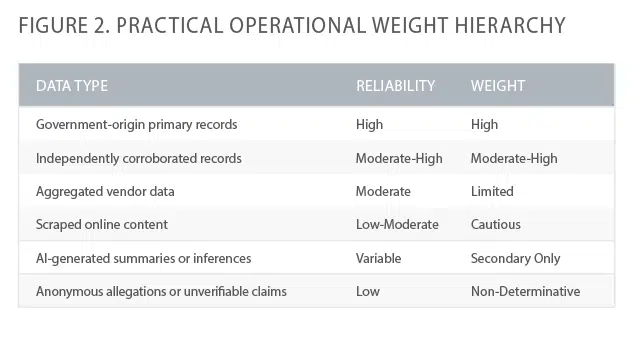
Failure in this category might look something like a vendor platform flagging a borrower as “associated with litigation risk” based on a name match, scraped article, existence of a lawsuit (actually dismissed in borrower’s favor), or a non-verified business affiliation.
An underwriter, pressured by speed and volume, accepts the flag at face value without tracing the underlying evidence, introducing potentially false, contextless, or irrelevant information into a financial decision.
Assessing appropriate weight assumes the data should have been collected in the first place.
Justify Collection and Usage
One of the most erroneous assumptions in lending intelligence is that if the information is publicly available, its use is automatically justified. A borrower may technically expose information online without reasonably expecting it to become part of a permanent underwriting profile, and they are beginning to recognize when firms engage in invasive or opaque information gathering.
Similarly, scraped data may capture outdated, misleading, or sensitive material that bears little relationship to creditworthiness or repayment capability.
Lenders must create clear policies defining what information may and may not influence decisions, and why. Those policies should be tailored to specific products and underwriting criteria, covering when and how data may be collected, used, and weighted to ensure consistent application across loan files.
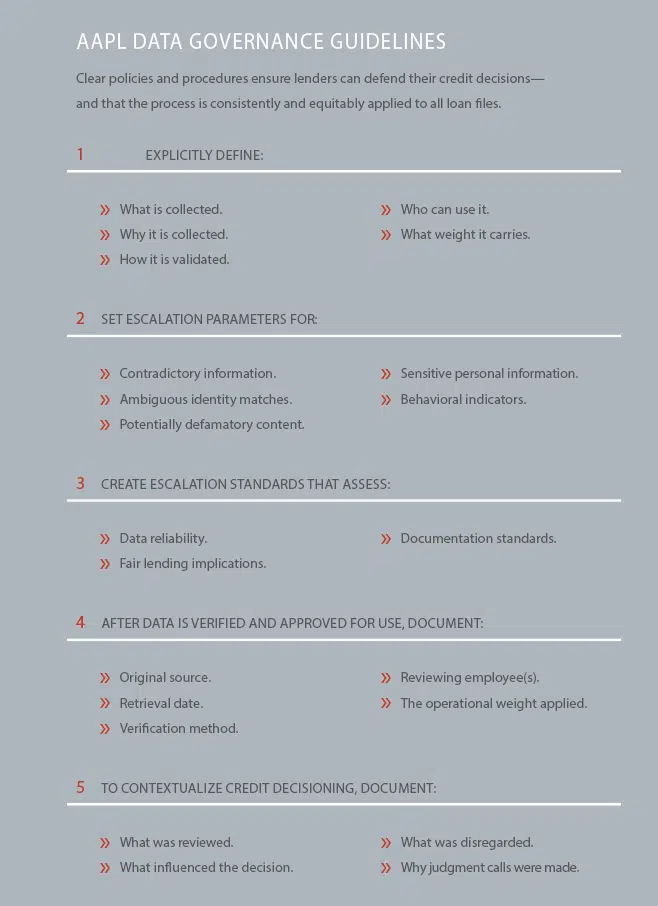
Governance as Strategic Risk Management
Private lenders now operate within an information ecosystem in which public records, aggregated datasets, and AI-generated intelligence coexist without clear boundaries. The absence of structure invites operational inconsistency and institutional vulnerability.
Many firms incorrectly view data governance as a friction layer that slows decision-making. The reality is that weak governance creates inefficiency. These commonly present as false positives, inconsistent underwriting, overdependence on vendors, and increased remediation costs.
A disciplined governance model forces lenders to separate meaningful intelligence from informational clutter.
The future of borrower intelligence will be defined by how responsibly lenders distinguish reliable evidence from speculative inference.







Leave A Comment