

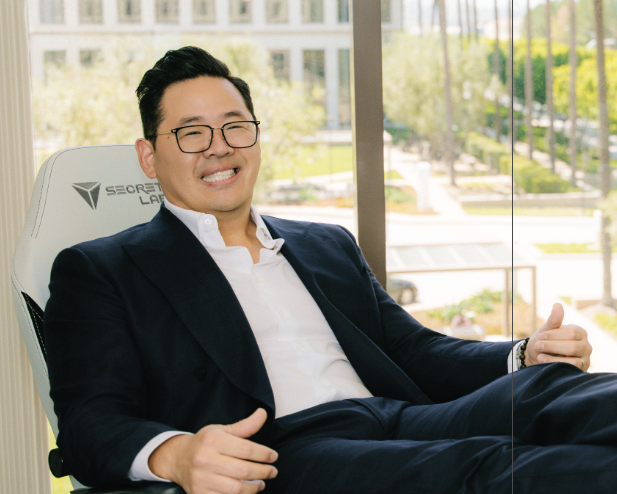
Huy Do never chased the version of success everyone expected him to want.
Gary Wallace, PrideCo’s head of originations, was finally taking an actual vacation. His usual version of time off meant the golf course and “like two cigars a round kind of thing.” This time was different: Italy and France, with roughly 95 borrowers, brokers, and follow-ups neatly left on a list for his boss to handle.
Huy Do, Gary’s boss and PrideCo’s managing member and CEO, slid back into the origination chair he’d occupied years earlier.
Then came the texts. The calls that became voicemails. The LinkedIn and Slack messages. The emails from everywhere.
“I was going to lose my mind,” Huy recalled. “But I was very thankful.”
For nearly two decades, Huy has kept the books running and wheels turning for the Newport Beach family office. Before Gary’s 2018 hiring, Huy had been the person living inside the origination part of the business. Eight years later, he was finding out what happened when somebody else took it over.
It was better. Huy describes Gary as “very similar to me, high touch,” and “very personable.” He’d turned originations into a broader business development role, handling branding, marketing, and the long-term relationships that kept PrideCo connected to brokers and borrowers. “People love him,” Huy said.
Gary was also the only one doing it. Huy had held the line on staffing a larger team of brokers, partly because of the hiring and firing that comes with that model and partly because, in the family-office business, relationships are the wealth. Gary had developed his own version of the job, one that Huy could not step into without suddenly finding himself responsible for 95 relationships at once.
The Entrepreneur Who Wasn’t
Huy grew up watching his father spot an opening and go after it. When the family escaped Vietnam’s political upheaval in the 1970s to settle in Iowa, his father worked the graveyard shift behind a butcher’s counter, where he saw an Asian immigrant community with few places to buy familiar foods. He started an import-export business, traveling back to Vietnam and Thailand to source fresh fruit and other foods, then shipped them to San Francisco for distribution to Asian groceries.
For a decade, the math worked. But fresh food was too vulnerable to contamination in transit, so he shifted to canned goods. His competitors flew the produce in.
So he pivoted again: restaurants, then a bakery. His first restaurant was simply called “Chinese Food” because it was the only Asian restaurant in Sioux City—and the entire state. The governor was a regular. Then someone opened a second Asian restaurant. Then another. Foot traffic thinned.
“He had all the energy to get things started—to be first in a new space—but none of the passion to keep it going,” Huy recalls, describing his father as “scrappy and entrepreneurial.”
Huy studied accounting at Pepperdine, earned an MBA in entrepreneurship at USC, won business-plan competitions, and collected the plaques and prize money of an aspiring founder. During the early stages of his career, he rotated jobs on a timer, working at Arthur Andersen, a Bluetooth technology company, Aramark, and an asset-based lending fund.
“I had been a two-year guy,” Huy said. “It took me a year to understand what was going on. It took me a year to try to innovate things. Then I was good.”
Eventually, the pattern stopped reading like restlessness in search of an entrepreneurial calling and started resembling a signature.
“I just wasn’t the guy,” he said. “I would take the guy’s creation and help grow that.”
The Number He Didn’t Chase
When Huy joined PrideCo in 2008, he had to learn how to operate inside a family office, including Googling what one actually was. “I’m not a Gen 2 or Gen 3, but I work for the family,” he explained.
Huy was there to help build the engine that would manage the family’s wealth after the sale of a 30-year-old manufacturing business precipitated PrideCo’s launch three years earlier. He would go on to handle accounting, investments, estate administration, and the search for investment vehicles to protect and grow the family’s wealth. Private lending became one line on a much longer ledger.
“So we got into real estate lending because it was like, okay, everybody else is doing it,” he recalls. “Every wealthy family has made a hard money loan, right? So we might as well do it too. And then it’s like, I think this is a business.”
Initially, Huy was every guy on the org chart—originating, underwriting, servicing, depositing checks, driving out to properties.
Then came the fund in 2010.
“When I took on the first outside money for the lending fund, it was nerve-wracking,” Huy said. “I had a fiduciary responsibility, never wanted to lose money.” He knew the families, and even though they had substantial wealth, they were entrusting him with a $5 million or $10 million investment. He was still learning the lending market. What if the deals went bad? What if everything froze? What if he ended up working the loans out himself?
I kept snagging on the same loose thread. The family office was also other people’s money. Huy had a fiduciary responsibility there, too. So what made the outside investor feel heavier?
He paused.
“I didn’t look at it like that,” he said. “And I wish I would have.
“With the family, you know the whole picture,” Huy explained. With outside investors, he could see the money they had committed, but not the rest of the balance sheet. He could only make sure the piece in his hands didn’t go bad.
“I’m probably too risk-averse,” he said, describing himself as someone who can spend too much time “counting the nickels and missing the dollars or $100 bills out there.”
When he looks at peers who started in the same place, he can see a PrideCo that never left the pro forma. It’s the “could-haves”: raising outside capital, pursuing acquisitions, or simply pushing harder on growth. He can list the levers he chose not to pull, including hiring more originators, entering new markets, or following the consolidation strategies many lenders adopted during periods of rapid growth.
“I could have been 10x,” Huy said.
The Compromises He Refused
On paper, the number reads like the setup to a sports-injury story. Huy, however, is thinking about something else entirely.
At Arthur Anderson, Huy worked 80 to 120 hours a week. He covered roughly 25,000 miles and four time zones a month at Aramark. He was single then, and he knows that was part of what made the pace possible.
He had also grown up watching what that pace could cost. Huy played basketball in high school (although he cheerfully itemizes his contribution as “benchwarmer”). His team was good enough to rank No. 24 in the country and No. 2 in the state. “I remember my dad going to one basketball game in my whole high school career,” he added.
“He was working as hard as he could because he was an immigrant, trying to provide a life for me,” Huy recalls. What stayed with him was the arithmetic of the absences: His father spent years traveling around the world to build businesses, which meant missing much of his son’s key moments.
So Huy set a ceiling on his own ambition—the one place he’s ever deliberately built one. He calls himself a “max two-night away kind of guy” and a “once-a-month traveler.” A two-hour flight is the outer limit. Vegas works. Miami or New York gets handed to someone else.
“Anywhere further, I send Gary,” he said.
Huy has designed his career to leave room for the things he refuses to miss, and he wants the people around him to have the same.
“Take your vacations, use your PTO, take your time, attend your concerts and your games,” he said. “I don’t want to stand in the middle of that because I don’t want that for me. And I’ve specifically designed my office and my life to not reflect that.”
Huy has already done the math on what a 10x ambition could cost in time. Now he’s trying to make sure there’s still headroom for others.
“The challenge for me is trying to figure out programmatically how to grow in order to have a better ceiling for my team,” he said. “You know, they don’t want to work at a stagnating business that only meets the needs. They want to see how they can excel.”
When Huy talks about Bergen Meyer, PrideCo’s loan operations manager, he skips past the job he thought he was hiring for—someone to keep the seat filled—and goes straight to the operation she built instead. He knew of her through her husband, a loan broker he once tried to hire, and kept track of the family. When another employee left, he hired Bergen.
Three years later, the rehab-management operation is, in his words, “light years different than what I created.”
Then he ticks through the details. Bergen tests assumptions against the company’s accumulated data, compares budgets as projects change, tracks inspections and payments, and builds processes around property taxes, insurance, and the people doing the work.
There is one small recurring snag in interviewing Huy Do for a story about Huy Do: getting Huy Do to talk about Huy Do.
Ask him about himself, and the conversation has a way of migrating toward somebody else.
The Details He Won’t Forget
It’s in his job description to watch founders make decisions, then track what happens after the transaction is over: what they were good at, where they struggled, and what actually seemed to matter to them.
He says he’s stopped worrying about being the person at the center of the room and started paying closer attention to the people already in it.
He collects two or three details, files them under a name, and never misplaces them again. “Everything becomes relational,” he explained. Huy makes it sound almost clinical. In practice, it’s remarkably personal.
Before the interview really began, Huy opened our conversation by asking about recent camping trips with the kids, remembered I had moved, and wanted to hear about the greyhound, Daisy, we recently adopted.
“I remember a couple things that make you different or special or stand out to me,” he says, and then self-deprecatingly, “And then I’ll ride that as long as I can.”
For Huy, the deal and the person attached to it are part of the same story. “There’s transaction,” he said, “but on the other side, you’ve got the human stories.”
He remembers a hedge-fund manager whose fund lost roughly 30% of its assets during the financial crisis, dropping from $500 million to $350 million. Six months later, Huy saw him again. The fund was bigger, the suit was nicer, the Rolex was more expensive, and the business card had changed.
“That guy’s looking for trades, looking to make money in AUM,” he remembers thinking. “Probably not a guy that we would invest with long term.”
Reading other people’s patterns is second nature. The harder work is deciding what to do with those he sees in himself.
The Things He Won’t Fix
When something goes sideways with his kids, “I’m on it right now.” He remembers an issue involving one of his teenagers when his first impulse was to call the parents, intervene, and solve it. His wife talked him off the ledge. “Let’s let it play out for a couple of days or a week,” she told him.
That instinct follows him to work. Huy admits that, in his own mind, he does “the best job ever.”
“I will grind it out and make it work,” he said. “And other people won’t do it as well. I would have formatted Excel better, something stupid like that, right? Or I would have said it in a different way—there’s nuance to how you send emails.”
One of PrideCo’s people is, as Huy puts it, “heavy paper.” Consolidations, QuickBooks, everything gets printed. In a digital world, that slows the pace considerably.
“It would take me 30 minutes to do. And so, I’m like—I think I’m done,” Huy said. But PrideCo’s cofounder and Gen 2 in the family advised he give it time. And that’s turned out to be a good thing.
If Huy touches it, his 30 minutes is never just 30 minutes. “I’m going to clean this up and clean that up… it’s idiotic. I’m paying dollars for it to be someone else’s, but it feels great.”
“People have been able to further their careers, see a higher ceiling, and then also build things where I don’t have to be the one that is coming up with the idea or anything like that,” he said, speaking of what he considers his top accomplishment. “They’re actually innovating the business without me.”
Somewhere in Europe, Gary Wallace was still on vacation, and Huy Do was discovering what his own success looked like from the wrong side of the desk: staring at a list of 95 names and wondering how he was going to survive the week.
Huy didn’t need to reclaim the origination chair to do “the best job ever.” He’d built an organization where Gary could make himself the guy for that.




Leave A Comment