

The industry’s fastest-growing segment is slowing, rates are becoming more reactive, and competition is shifting from expansion to market share.
This year has introduced a more nuanced lending environment than many expected coming out of 2025. After a period of strong, consistent growth, particularly in DSCR lending, the market appears to be finding a new equilibrium as certain product categories grow more sensitive to broader economic conditions.
What’s emerging is a rebalancing of loan products, rate behavior, and regional activity. The following analysis looks at how bridge and DSCR lending have performed through the first four months of 2026, and what those patterns may signal for the rest of the year.
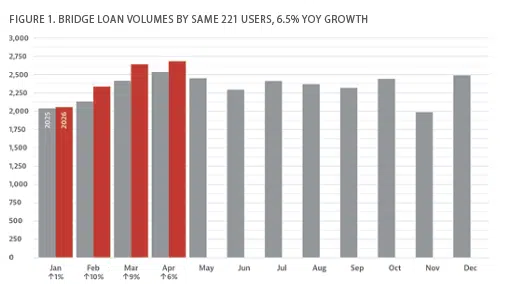
Bridge Lending Settles into the Pace
Figure 1 shows how bridge loans have stabilized and continued tepid growth leading into the second quarter of 2026. Each month has brought steady month-over-month increases, while year-over-year growth remains modest. April 2025 set a record high for bridge loan transactions that took nearly a year to match again.
When Lightning Docs data is compared to broader industry sources, several trends stand out among the top 100 private lenders. First, this group also experienced modest growth of 2.2% from first quarter 2025 to first quarter 2026. The real story, however, is who grew and who decreased in volume. As Figure 2 shows, of the top 100 lenders, 58 grew their business. This group actually showed significant growth, with an average increase of 51%. On the other hand, 41 of these lenders decreased their volume and did so by an average of -23%.
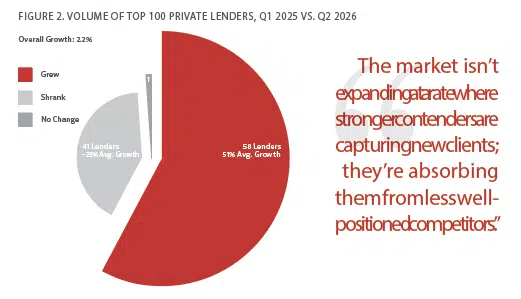
This significant jockeying for market share amid nominal industry growth indicates internal factors in play. Adaptability is becoming a key differentiator, whether through new product offerings, expansion into new markets, or the adoption of new technology. The market isn’t expanding at a rate where stronger contenders are capturing new clients; they’re absorbing them from less well-positioned competitors.
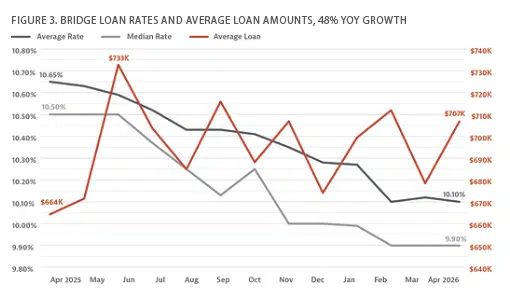
Average bridge loan interest rates have trended downward on a national level for some time. As of February 2026, however, that trend began to flatten. With other benchmark rates rising during the same period, bridge loan pricing may soon follow a similar path. Macroeconomic factors, particularly developments tied to global conflict and oil prices, will play a key role in how this segment adjusts. Average loan amounts have fluctuated over time but appear to be anchored around the $700,000 mark. See Figure 3.
DSCR is back with the pack
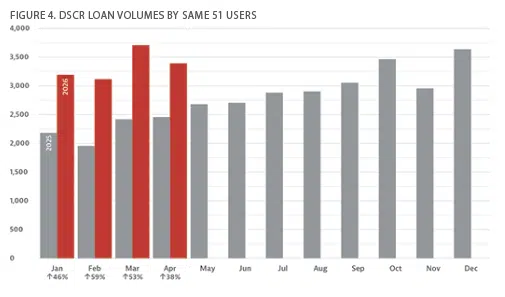
Strong DSCR growth became the expectation throughout 2025, with year-over-year volume increasing by 91% from 2024 to 2025. That pace has moderated so far in 2026. As Figure 4 shows, year-over-year growth remains strong at nearly 50%, but the month-to-month trend tells a different story. After setting record highs in 10 of 12 months last year, 2026 has produced just one new monthly record high so far. This may signal an early rebalancing between bridge and DSCR lending following DSCR’s outsized growth in 2025.
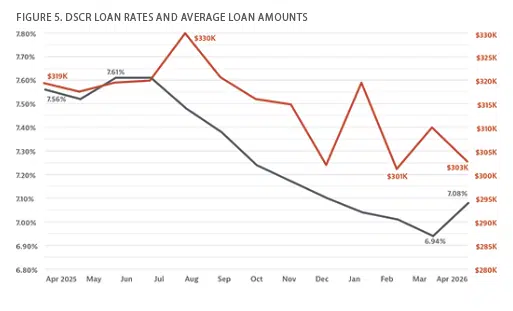
DSCR interest rates had been following a similar downward trajectory as bridge loan interest rates, but they have proven more reactive to macroeconomic conditions entering the second quarter of this year, as you can see in Figure 5. After briefly dipping below 7%, rates increased by 14 basis points in April, marking the largest monthly jump since 2024. Loan amounts continue to fluctuate but generally remain centered around $300,000.
The climb begins
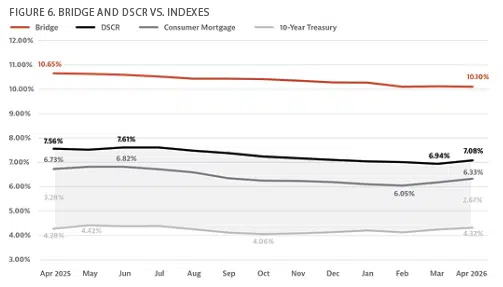
As noted, bridge loan rates have flattened while DSCR rates have responded more directly to movements in the broader market, as Figure 6 shows. This aligns with increases in the 10-year Treasury yield and consumer mortgage rates. Although private lending rates are still influenced by these external benchmarks, it is encouraging that spreads between DSCR rates and the 10-year Treasury have remained below 3%, demonstrating significant capital markets’ demand to purchase these loans at attractive rates. In fact, many private lenders can offer more attractive financing than the large consumer mortgage lenders that also offer DSCR loans, largely because the big players carry significantly higher compliance costs that drive up their cost to produce loans.
Positioning Matters
Figure 7 shows the clear hierarchy among states for bridge loans. California, Florida, and Texas continue to hold the top three positions, with California maintaining a significant lead. Beyond that, there has been notable movement within the top 10. Ohio, in particular, has climbed five spots to reach the No. 4 position through the first third of 2026, despite not having a single county among the top 10 markets.
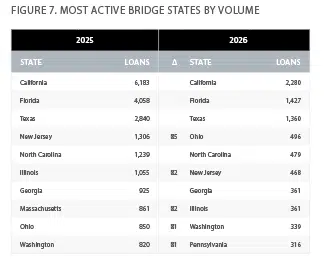
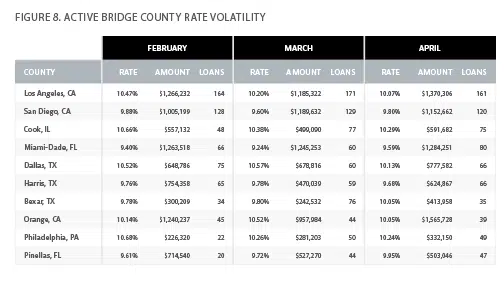
Figure 8 shows that at the county level, California, Texas, and Florida markets dominate bridge loan activity, as expected. However, differences in volatility are worth noting. Counties such as Los Angeles, San Diego, and Orange show consistent, predictable volume month to month. In contrast, markets like Bexar County, Texas (San Antonio), and Philadelphia, Pennsylvania, have demonstrated the ability to more than double output from month to month, highlighting pockets of more dynamic activity.
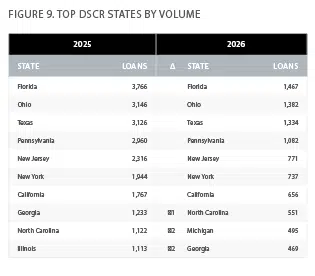
As you can see in Figure 9, the top states for DSCR lending have remained remarkably consistent from 2025 to 2026, with the top seven states maintaining the same order. As DSCR activity continues to expand geographically, states such as Missouri, Illinois, and Maryland, which currently sit just outside this list, are well positioned to enter the top 10 in the near future.
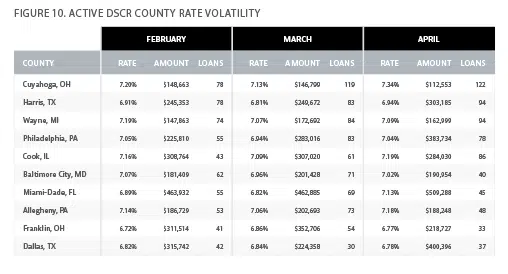
At the county level, shown in Figure 10, the top three leading DSCR markets continue to show increasing volume month-to-month. Cook County, Illinois, typically the No. 3 market, is gaining traction after a slower start to the year. Baltimore City, Maryland, has significantly exceeded expectations and stands out as the only top-performing county from a state not currently ranked in the top 10.
Reading the Course
Taken together, the data from the first four months of 2026 point to a market in transition.
Bridge lending is showing renewed stability, with consistent, but modest growth and record-setting volume returning after a slower end to 2025. DSCR lending, while still delivering strong year-over-year gains, is beginning to normalize after a period of rapid expansion, with growth becoming less predictable on a monthly basis.
At the same time, interest rate dynamics are shifting. The prolonged decline in rates appears to be leveling off, and in some cases reversing, as broader macroeconomic pressures begin to reassert themselves. That shift is already influencing borrower behavior, loan pricing, and overall transaction flow.
For private lenders, this environment places a greater emphasis on adaptability. The opportunities remain strong, but performance in the months ahead will be shaped less by broad market tailwinds and more by how effectively lenders respond to a more balanced and increasingly rate-sensitive landscape.







Leave A Comment