

Most valuation risk hides in predictable gaps, if you know where to look.
Defensive Driving Rule #1: Check your blind spots. All drivers have them—areas outside our natural line of sight. The risk isn’t their existence; it’s pretending they aren’t there. Smart drivers build habits that force them to check their blind spots to reduce avoidable danger situations and protect themselves, their passengers, and their property.
The same holds true in lending—whether it’s DSCR, renovation, or construction. Our workflows are built for speed and efficiency, but speed creates blind spots. Those gaps aren’t obvious unless we deliberately look for them. In valuation, particularly with heightened awareness around appraisal fraud, those gaps can carry serious consequences. The good news is they don’t have to remain vulnerabilities.
The first step is identifying where risk tends to hide, what can slip through unnoticed, and how to surface it without sacrificing efficiency or cost control.
Appraisal Risk Has Never Gone Away
Appraisal risk, for example, has been a known issue for decades. It was one of the primary reasons Fannie Mae developed their Collateral Underwriter model, which produces a CU score designed to convey appraisal risk with simplicity. Released to the public in January 2015, the tool is powerful and fast, although it has gaps. The CU analysis largely looks at issues within the appraisal XML file itself, mainly related to compliance flags, and also compares information from other appraisals that Fannie Mae has on file.
For example, items flagged by CU can include flagging comp condition compared to its year built. This means that if the appraisal says a certain comp built in 1920 is in a C2 condition (generally understood as “fully remodeled”), then the CU model is likely to flag this comp as a potential concern. In reality, though, in many markets, there can be a lot of comps that are more than 100 years old that have been fully remodeled and sufficiently reflect a true C2 condition.
In contrast, you could have a comp built in 2012, with an appraisal rating of C2. Within the CU platform, it is less likely to receive this flag. However, the CU process does not conduct or pull any cross-reference intelligence to analyze listing remarks, listing photos, or other metadata to cross-reference the expected condition ratings for any of the comps. This means the condition flags within CU may simply create more noise and more work for a rewriting/review team rather than flag tangible issues or concerns.
When Automated Flags Fall Short
Although the CU flags are helpful, they often take the ball only “halfway up the field,” leaving the underwriting or review team without clear action items or independent comparison metrics. You can see the fundamental flaw here.
Even with this being the comparison base, Fannie Mae says they typically find over 50% of appraisals have at least one material flag, either for compliance, accuracy concern, or both. That’s a staggeringly high number, which conveys how prevalent the issues are and how critically important it is to develop an effective process to evaluate and minimize appraisal risk.
Where Blind Spots Hide
Risk can hide in multiple places. When you understand them and know where to look for them, you can develop a systematic, effective, and scalable review process.
Risks fall into two groups. Group one includes five categories that are easily accessible for processors and employees without significant levels of prior expertise:
Comp Distance
Comp Similarity
Subject Condition
Comp Condition
Comp Sale Prices
Group two includes three categories that do require a bit more expertise, as well as some hyperlocal assessments to derive trustworthy conclusions:
Comp Adjustments
Adjusted Comp Sale Prices
Value Conclusions
What the Data Reveals
Live beta testing in January and February 2026 of RicherValues’ new OverSight product—an automated real-time appraisal tool—revealed that 74% of analyzed appraisals (Forms 1004, 1007, and 1025) contained at least one Group One concern, and 52% contained at least one Group Two concern (see Fig. 1).
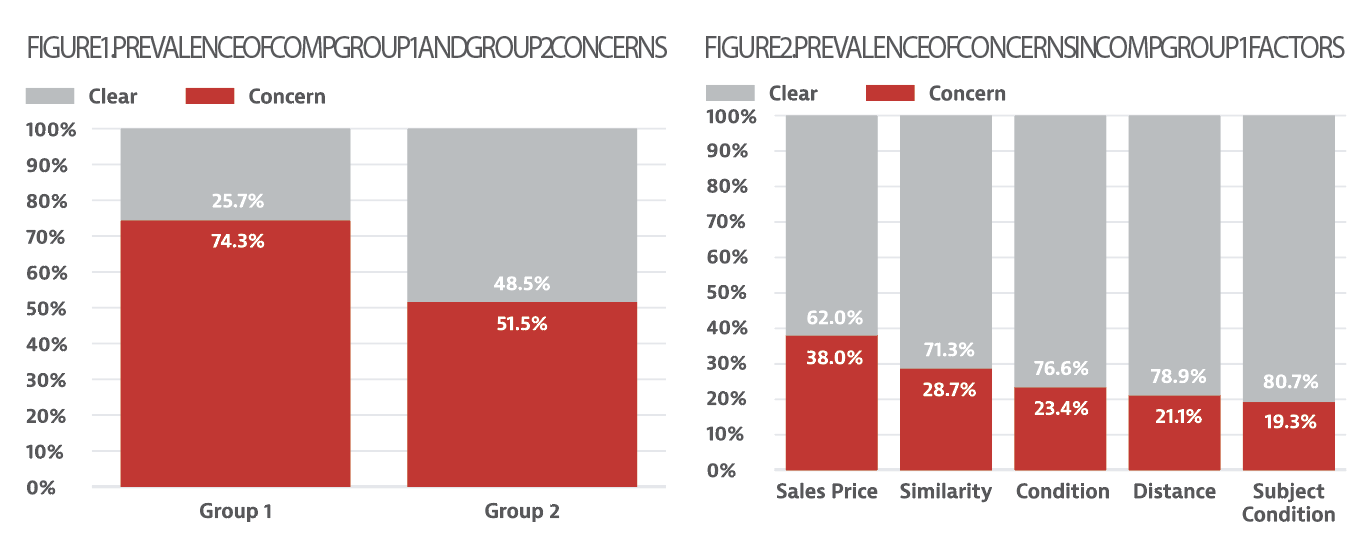
Among Group One factors, the two factors with the highest prevalence of concerns can be easily identified with some simple checks and balances: comp sales prices and comp similarity (see Fig. 2).
The comp sales price factor highlights when an appraisal relies on the highest-priced comparable sales in the area, particularly within a defined size range (e.g., ±20% of the subject property’s square footage). If one or more selected comps rank among the top three highest sales in the entire market, that should prompt closer scrutiny. Although there may be legitimate reasons for those selections, consistently choosing top-tier sales can signal potential bias, value inflation, and ultimately potential appraisal risk.
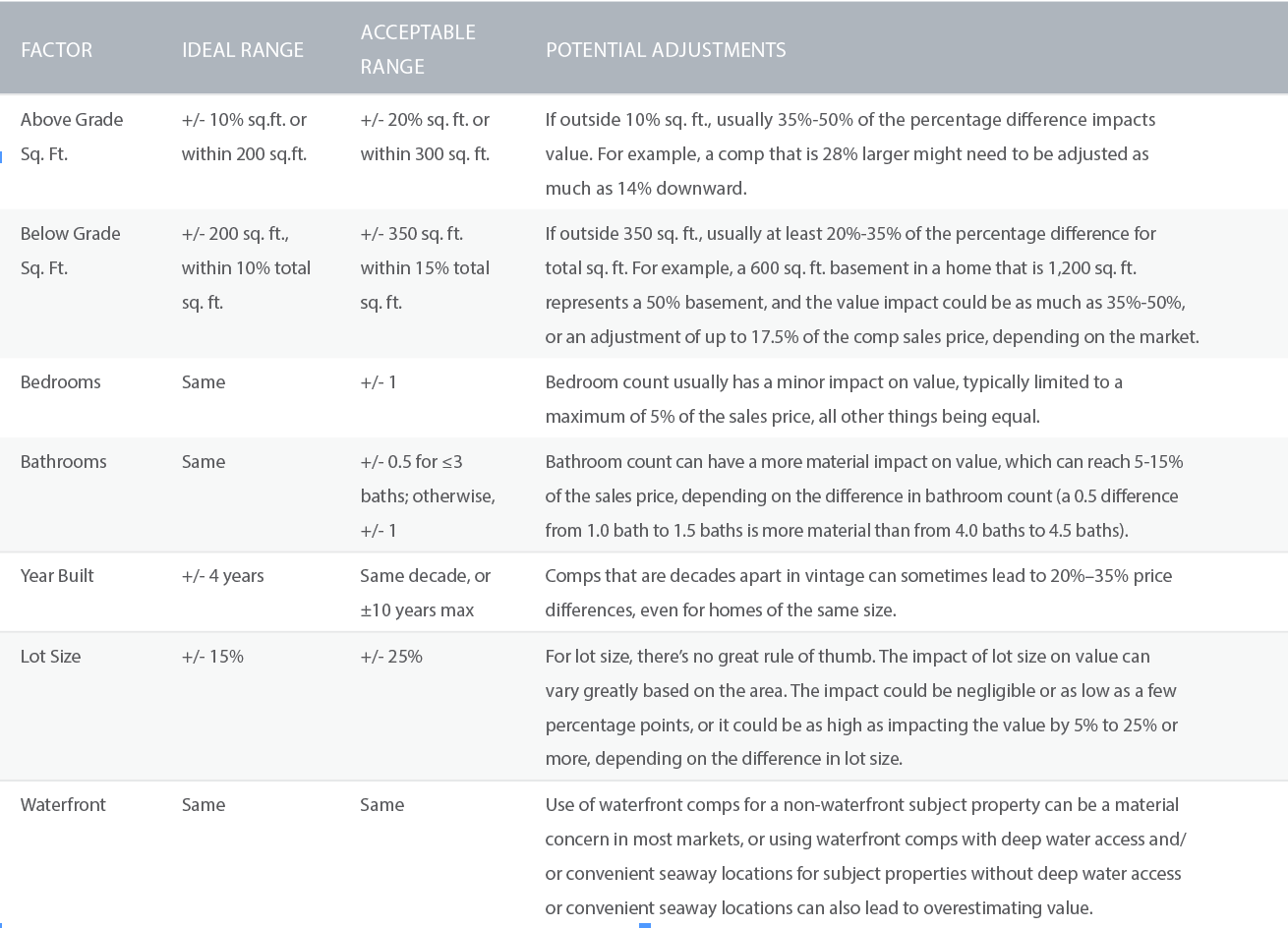
The comp similarity factor refers to the similarity of property specs compared to the subject property. This covers items such as above-grade square footage, below-grade square footage (finished), bedroom count, bathroom count, lot size, year built, and/or other factors. It can be acceptable to include comps that appear somewhat dissimilar from the subject property, although these differences need to be adequately adjusted. For example, seeing differences in above-grade square feet of more than 15% or 300+ square feet, with only small adjustments to comp sales prices, or without any adjustments at all, could indicate the appraised value is overinflated for the subject property.
Figure 3 provides some rules of thumb for how much variation is acceptable without adequate comp adjustments being applied. These thresholds are not hard rules. Every hyperlocal neighborhood is different, and the impact of each adjustment factor can vary significantly by neighborhood.
Measuring the Group Two factors requires a bit more expertise and ideally an effective use of data and technology. We will explore those factors in greater depth in our next article.
Until then, remember that having blind spots is natural and understandable. Continuing to operate without checking your blind spots, on the other hand, is negligent. Take the time to understand your blind spots so you can develop scalable, systematic, and effective ways of checking them before you hit the gas again. That way, you can close your loans with speed—and with precision and safety.







Leave A Comment